

 DirectStay
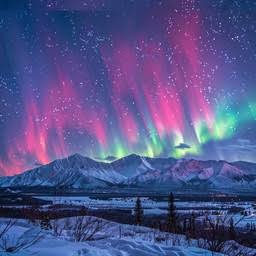
Northern lights viewing in the Mat-Su Valley filters on one variable before anything else: how high you're willing to drive in the dark. Hatcher Pass climbs to nearly 3,900 feet above the valley floor, where the winter parking area below Independence Mine sits above the cloud layer that traps everyone else. On a clear night at that elevation, the aurora doesn't appear on the horizon — it fills the sky above you while the Talkeetna Range frames every edge. Then there's the version that asks nothing of your nerves or your tires. The Knik River Valley spreads flat and open twenty minutes south of Palmer, where the northern horizon holds no mountains and the sky stretches wide enough that even a low-activity aurora registers. Between the two sits a 35-foot viewing tower at Reflection Lake in Palmer Hay Flats, where elevation is negligible but light pollution is almost nonexistent and the lake surface doubles what's overhead. Every aurora night in this valley starts with the same question, and the sky you see depends on how you answer it.
The winter parking area below Independence Mine State Historical Park sits at roughly 3,500 feet on Hatcher Pass Road, about thirty minutes from Palmer. The road is paved to this point and maintained through winter, though snow and ice are standard — studded tires or chains belong on the vehicle before you leave town.
What elevation buys you is separation from the valley's weather. Fog and low clouds settle into the Mat-Su basin on still autumn and winter nights. At valley level, that fog erases the show. At Hatcher Pass, you're above it. On nights when Palmer sees nothing but gray, the parking area at the mine can sit under a clear ceiling with the aurora spreading north to south across a sky framed by ridgeline silhouettes.
The trade-off is real. No cell service at the upper parking area. No restrooms in winter. No warming shelter. Temperatures at elevation run fifteen to twenty degrees colder than the valley floor, and wind accelerates through the pass. The drive down at 2 AM on an icy road after staring at bright light for hours requires attention and confidence behind the wheel.
But on the right night — forecast strong, sky clear, wind calm — nothing in the Mat-Su Valley matches what Hatcher Pass puts above your head.
Twenty minutes south of Palmer, off the Old Glenn Highway, the Knik River drainage opens into a wide gravel floodplain backed by the Chugach Range. The northern horizon here holds no mountains, which matters more than most visitors realize: the aurora often appears low on the horizon before it climbs overhead, and any ridgeline between you and north clips the first hour of the show.
Eklutna Tailrace, near the beginning of the valley, is the spot local photographers return to. Easy road access, multiple pullout areas, and enough distance from Palmer and Wasilla that city glow fades to background. The Knik River Bridge area and the gravel bars beyond it offer darker sky and wider angles, though unfamiliar terrain at night demands a daylight scouting trip first — river gravel can be unstable, and ice shifts the landscape between visits.
What the Knik River Valley gives you is low commitment. No mountain driving. No elevation risk. If the forecast disappoints or clouds roll in, you're twenty minutes from a warm bed.
Palmer Hay Flats State Game Refuge sits at Mile 30.6 on the Glenn Highway, accessible via the Knik River Access exit. A one-mile loop trail leads to a 35-foot wildlife viewing tower on the northwest side of Reflection Lake — a structure built for daytime bird watching that doubles as an elevated aurora platform on dark nights.
The tower faces north and west with unobstructed sightlines across the 28,000-acre refuge. Light pollution here is minimal — the Glenn Highway runs nearby, but the wetland expanse absorbs what glow reaches it. On still nights, the aurora reflects off Reflection Lake's surface, doubling the display. The trail to the tower is ADA-compliant at the lower level, and the parking area is a short walk from the lake.
This is the option that works for families, for visitors without winter driving experience, and for anyone who wants an aurora attempt without leaving paved infrastructure far behind. The tower sits at valley level — clouds can block what Hatcher Pass would rise above. But on a clear night with active aurora, the combination of dark sky, open horizon, and lake reflection creates something worth the drive.
🏠 HOST INSIGHT OPPORTUNITY: "What do your guests usually get wrong about this spot, or what do you always tell them before they go?"
✅ IF HOST PROVIDES WISDOM: "But the thing most visitors don't realize is [HOST INPUT HERE]."
⬇️ ALTERNATE (if no host wisdom): "But the pattern locals follow is checking the forecast twice — once at dinner, once at 10 PM — because conditions shift fast at this latitude. The guests who see the aurora are the ones who stayed flexible and dressed warm enough to wait."
The Glenn Highway between Palmer and Sutton runs east-west through stretches of low light pollution — keep a tripod in the car during aurora season and pull over when the green starts. Talkeetna, ninety minutes north, sits in a corridor of minimal light pollution with unobstructed Alaska Range views; Talkeetna Riverfront Park places the Susitna River between you and the northern sky. Nancy Lake State Recreation Area near Willow offers dark skies and lake reflections from backcountry cabin positions with no artificial light for miles — the version that costs the most preparation and delivers the most immersive result.
Aurora season in the Mat-Su Valley runs from mid-August through mid-April. The strongest windows typically fall September through October — nights darkened but temperatures manageable — and February through March, when solar activity historically strengthens. The 2025–26 season remains strong as the solar cycle follows a gradual arc past its 2024–25 peak.
The University of Alaska Fairbanks Geophysical Institute publishes aurora forecasts updated daily at gi.alaska.edu/monitors/aurora-forecast. For Mat-Su at 61.5°N, moderate activity typically produces visible aurora; strong activity fills the sky. But two variables matter equally: solar activity and cloud cover. A strong forecast under clouds produces nothing. A moderate forecast under clear skies can surprise you. Check the forecast at dinner. Check it again at 10 PM.
Allow twenty minutes for your eyes to adjust to darkness. Camera settings for aurora photography: wide-angle lens, sturdy tripod, aperture f/2.8 or wider, ISO 1600 to 6400, exposures ten to twenty seconds. The guests who see the aurora are rarely the ones who set an alarm — they're the ones who stayed up, stayed warm, and stayed patient.
Elevation viewing (Hatcher Pass): Winter parking area below Independence Mine, Hatcher Pass Road. Approximately thirty minutes from Palmer. Road maintained but winter conditions standard — studded tires or chains recommended. No cell service, no restrooms, no warming shelter at upper lot. Check road conditions at 511.alaska.gov and the Hatcher Pass webcam before driving.
Flat-horizon viewing (Knik River Valley): Old Glenn Highway south of Palmer, approximately twenty minutes. Eklutna Tailrace area and Knik River Bridge area are common starting points. Scout in daylight before visiting at night — gravel terrain shifts seasonally. Dress for river valley cold, which can be sharper than town temperatures.
Tower viewing (Palmer Hay Flats): Reflection Lake, Mile 30.6 Glenn Highway, Knik River Access exit. One-mile loop trail to 35-foot viewing tower. ADA-compliant lower level. No fee. Open year-round. Short walk from parking.
Forecast tools: UAF Geophysical Institute aurora forecast: gi.alaska.edu/monitors/aurora-forecast. NOAA Space Weather Prediction Center: spaceweather.gov. Check both forecast and cloud cover before committing to a drive.
What to bring: Layers rated for twenty degrees below your expected temperature. Hand warmers. Thermos. Headlamp with red-light mode to preserve night vision. Tripod and camera if photographing. Patience.
Lodging note: Aurora season coincides with the Mat-Su Valley's quieter months. Visitors staying in surrounding communities have the advantage of flexible evening departures — check the forecast after dinner, drive to your chosen spot if conditions align, and return to a warm rental when the show fades or the clouds win. Booking lodging in advance opens up properties in darker, quieter locations where the aurora may be visible from the deck.
Want to feature your business on the DirectStay Blog?
Want to feature your business on the DirectStay Blog?

Connect with travelers, share your space, and join a community of hosts earning together.
Become a host