

 DirectStay
The Iditarod Trail Sled Dog Race arrives in the Mat-Su Valley every March carrying a question most first-time visitors answer wrong. They see coverage of downtown Anchorage — the banners, the crowds, the eleven-mile parade of sled dogs down Fourth Avenue — and assume they've found the event. They drive to Anchorage, stand in the snow, watch the teams mush past, and go home believing they saw the start of the race. They didn't. The clock doesn't start in Anchorage. The clock starts the next day, on a frozen lake in Willow, a town of about two thousand people forty-five minutes north of Palmer. By the time those teams leave Willow, they won't touch a road system again until Nome.
That split — ceremonial start on Saturday, competitive restart on Sunday — is the single fact that reshapes how you plan the entire weekend. And it's the fact most visitors learn too late.
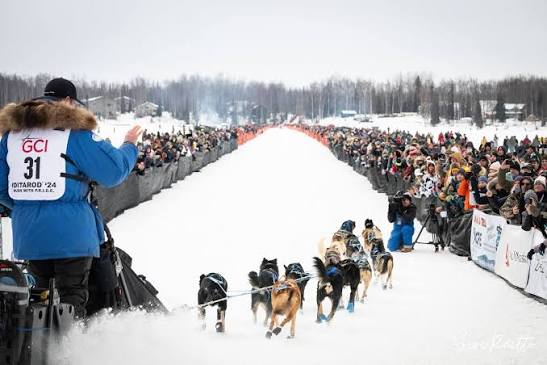
The ceremonial start fills downtown Anchorage on the first Saturday of March. Teams mush from Fourth Avenue through eleven miles of urban trails. Thousands of spectators line the route. The energy is festival-level — crowds pressed against barriers to watch dogs and mushers pass at close range.
But the ceremonial start is not the race. No clock runs. No positions are earned. After the run, teams load their dogs back into trucks and drive north.
What the ceremonial start does give you is access. You can get close to teams, watch mushers interact with their dogs, and absorb the atmosphere of a city that builds its early-March identity around this event. Anchorage Fur Rendezvous — one of the largest winter festivals in the world — typically wraps up the same weekend.
If the ceremonial start is all you see, you haven't wasted a trip. You've just watched the rehearsal instead of the performance.
Sunday afternoon at two o'clock, the real race begins. Teams depart Willow Lake in intervals, heading northwest toward the Alaska Range, the frozen Yukon River, the Bering Sea coast, and eventually Nome — roughly a thousand miles that most teams cover in eight to ten days.
The restart site sits adjacent to the Willow Community Center. The atmosphere is different from Anchorage — rawer, more focused. Mushers check gear and make final decisions about which dogs will run. Volunteers handle teams. The energy shifts from parade to purpose.
Spectators spread across the frozen lake, setting up what Alaskans call "trailgating" — watch parties with grills, music, and a direct line of sight as teams launch into the wilderness. A few miles beyond Willow, the trail separates from any road system. What you're watching at the restart is the last moment these teams are accessible without a snowmachine or a bush plane.
The mistake isn't choosing Anchorage over Willow. Both are worth experiencing. The mistake is not knowing they're separate events on separate days in separate locations — and planning for only one.
Visitors who fly into Anchorage for the Saturday ceremonial start and leave Sunday morning miss the restart entirely. Visitors who drive to Willow on Saturday find a quiet town. The race hasn't arrived yet.
The weekend works when you plan for both: Anchorage on Saturday for the spectacle and festival atmosphere, then a drive north to the Mat-Su Valley for Sunday's restart. Palmer sits roughly forty-five minutes from Willow and serves as a natural base — close enough for an early Sunday departure, far enough from Willow's tiny lodging supply to find space.
During restart weekend, the Mat-Su Valley shifts. Iditarod Trail Headquarters in Wasilla — the race's year-round home at 2100 S Knik-Goose Bay Road — becomes the nerve center. The free museum holds race artifacts, trophies, and videos. During summer, sled dog cart rides run daily for ten dollars, but during race week the headquarters carries a different charge — the staff is tracking teams, the media is present, and the history on the walls is being written in real time a thousand miles northwest.
Willow's lodging supply is minimal and fills early. Palmer and Wasilla absorb the overflow, but even those towns see tighter availability during Iditarod weekend. The earlier you book, the more options open up in surrounding communities where the space is larger and the nights are quieter.
The Iditarod alternates between a northern route (even years) and a southern route (odd years), both launching from Willow. Low snow conditions can force adjustments — the 2025 race rerouted to Fairbanks entirely. For most visitors, the route distinction matters less than this: the restart on Willow Lake is the last moment these teams are accessible to anyone without a snowmachine or a bush plane. After that, the wilderness takes over.
🏠 HOST INSIGHT OPPORTUNITY:
"What changes during this event that visitors don't expect? What do you warn guests about?"
✅ IF HOST PROVIDES WISDOM:
"But the part visitors consistently underestimate is [HOST INPUT HERE]."
⬇️ ALTERNATE (if no host wisdom):
"But the part visitors consistently underestimate is the cold. Standing on a frozen lake for two to three hours in early March is a different kind of cold than walking through Anchorage. Layers, hand warmers, and insulated boots aren't optional — they're what separate the spectators who stay through the last team from the ones who retreat to their cars after forty minutes."
Event: Iditarod Trail Sled Dog Race. Annual. Ceremonial start historically falls on the first Saturday of March in Anchorage; competitive restart on Sunday in Willow. Verify the current year's dates at iditarod.com.
Where (Restart): Willow Lake, adjacent to Willow Community Center. Willow is approximately 70 miles north of Anchorage and 45 minutes north of Palmer via the Parks Highway.
Where (HQ): Iditarod Trail Headquarters, 2100 S Knik-Goose Bay Rd, Wasilla. Free museum, year-round. Check hours and seasonal programming at iditarod.com/plan-your-visit.
Restart time: Historically 2:00 PM on Sunday. Teams depart at intervals. Verify current year's schedule at iditarod.com.
Parking: Limited at Willow. Shuttle buses typically run from overflow parking areas. Plan to arrive early or use shuttles.
What to wear: Dress for standing still on ice in sub-freezing temperatures. Insulated boots, layered clothing, hand warmers. Wind on the lake amplifies the cold.
Lodging note: Restart weekend compresses lodging supply across the valley. Willow has minimal accommodations that fill months ahead. Palmer and Wasilla offer more options and sit within an easy morning drive of Willow. Booking ahead opens up surrounding communities where the space is larger, the mornings are quieter, and the drive becomes part of the day.
Want to feature your business on the DirectStay Blog?
Want to feature your business on the DirectStay Blog?

Connect with travelers, share your space, and join a community of hosts earning together.
Become a host