

 DirectStay
A dog mushing day in the Mat-Su Valley pivots on a single question: do you want to understand the race or feel the dogs pull? Iditarod Trail Headquarters sits just off Knik-Goose Bay Road in Wasilla — a log-walled room where Togo, the sled dog who led his team across Norton Sound in the 1925 serum run to Nome, stands preserved among race bibs, trophies, and fifty years of photographs. You walk through a story that shaped Alaska's identity. Then there's a kennel off Hatcher Pass Road in Willow where an active Iditarod racing team lives, trains, and greets you at the gate — where the dogs who train year-round for the thousand-mile race are the same ones who'll pull your sled this afternoon, and the musher debriefing you on harness technique is a fourteen-race Iditarod veteran.
The Iditarod Trail Sled Dog Race Headquarters operates year-round as the administrative hub and public museum for the Last Great Race. Joe Redington Sr. — the "Father of the Iditarod" — and Dorothy Page began pushing for the race in the late 1960s to preserve the historic trail that once connected remote Alaskan villages and to keep mushing culture alive as snowmobiles replaced dog teams. The museum is the artifact of that effort.
Step inside and the room does the talking. Togo holds the central position — the lead dog who covered the most dangerous leg of the 1925 relay, crossing trackless Norton Sound in whiteout conditions to deliver diphtheria antitoxin to Nome. He's been stuffed and mounted, and standing near him recalibrates something about how you understand the relationship between humans and working dogs. Around him: race bibs signed by finishers, photographs of mushers crossing frozen rivers at forty below, trophies from decades of competition, and a thirty-minute film that covers the race's history from serum run to modern spectacle.
The museum is free. That matters. You can walk in without a plan, without a ticket, without a reservation, and spend an hour absorbing what this race means to Alaska before you've spent a dollar. The gift shop carries bibs from previous races and merchandise that funds the Iditarod Trail Committee, a 501(c)(3) nonprofit. The whole operation runs on what comes through the door.
In summer, the experience extends outside. Riley Dyche — a veteran Iditarod musher and 2025 top-ten finisher — runs sled dog cart rides on a quarter-mile loop around the dog yard. The dogs pull a wheeled cart at full sprint. It has historically cost around ten dollars. The ride lasts a couple of minutes, but what lingers is the sound — the moment the dogs hit the harness and the yard goes from resting to running. Dyche's dogs are race dogs. They don't distinguish between a tourist lap and a training run. They just go.
🏠 HOST INSIGHT OPPORTUNITY:
"What do you tell guests about these places that they wouldn't find online?"
✅ IF HOST PROVIDES WISDOM:
"But the part that changes everything is [HOST INPUT HERE]."
⬇️ ALTERNATE (if no host wisdom):
"But hosts who've sent guests to both have noticed a pattern: families who start at the museum first tend to get more from the kennel visit afterward — the context transforms the experience from a ride into a story they already understand."
Alaskan Husky Adventures operates from a private homestead in Willow — the town that typically hosts the Iditarod restart each March. Matthew Failor founded the 17th-Dog racing kennel in 2013 after years working under four-time Iditarod champion Martin Buser. In 2019, Matthew and his team won the Kuskokwim 300, breaking a speed record that Buser had held for twenty-five years. He has competed in the Iditarod fourteen times since 2012.
The tour operation launched in 2020 when Matthew's wife Liz — a former news anchor who'd been assigned to cover the race in 2018 and fell in love with the musher instead — lost her station job. They turned their home and dog yard into a business. The dogs who greet you at the gate aren't retired mascots. They're active competitors. Lead guide Dane Baker finished the 2025 Iditarod himself. Jaren Ulrich, another guide, recently completed his first hundred-mile race. The people running your sled have run the trail.
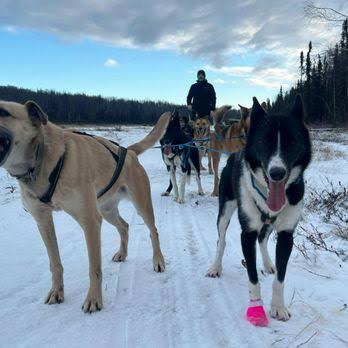
Winter rides put you on an actual sled behind a nine-dog team on a six-mile loop through private trails with Denali views. The ride takes forty-five minutes to an hour. Summer swaps the sled for a purpose-built cart — dog-powered, no motors — on the same trail system where the team trains for the race. Either way, you're moving behind dogs who understand pace, terrain, and command language at a level that makes the experience feel less like a tour and more like joining a training run already in progress.
What the kennel visit delivers beyond the ride is proximity to the mushing life itself. A life-size mannequin in full race gear — parka, bibs, boots, headlamp — stands at check-in, dressed head-to-toe in what a musher carries across a thousand miles. The bib is the one Matthew wore, signed by fellow racers from that year. After the ride, the dogs run loose in the yard, and the line between working athlete and family pet dissolves. You're standing in someone's home, surrounded by fifty-plus huskies who live here year-round, watching them play and watching the Failors interact with each dog by name. But what stays with you is the moment on the trail — when the snow hook lifts and the team launches forward and your hands tighten on the handlebar and you realize these dogs have been waiting all day for exactly this.
Iditarod Trail Headquarters: Knik-Goose Bay Road, Wasilla — two miles from the Parks Highway. Museum is free. Summer sled dog cart rides available mid-May through September. Check the Iditarod website for current hours and ride availability: iditarod.com/plan-your-visit
Alaskan Husky Adventures: 18408 W Reynolds Rd, Willow. Year-round tours by reservation. Winter sled rides and summer cart rides available — check akhusky.dog for current pricing, seasonal availability, and booking. Shuttle service from Anchorage available for an additional fee.
Combining the two: Wasilla to Willow is approximately thirty minutes by car. Starting at the museum and finishing at the kennel turns a half-day into a complete arc — from the race's history to its living present.
Driving note: The Parks Highway between Wasilla and Willow runs through moose country. Dawn and dusk crossings are common. Drive attentively, especially in shoulder seasons.
Lodging note: Both experiences work as day trips from Palmer, Wasilla, or Talkeetna. Booking a place to stay in the valley gives you the flexibility to schedule around weather and availability — particularly for kennel tours, which book ahead during peak summer months.
Two ways to understand the same thousand-mile question. One puts you inside a room where the race became history. The other puts you behind a team where the race is still happening. The dogs at the museum earned their rest. The dogs at the kennel are earning their next starting line. Either way, you leave knowing something about what it means to trust an animal with your momentum — and why Alaska made it the official state sport.
Want to feature your business on the DirectStay Blog?
Want to feature your business on the DirectStay Blog?

Connect with travelers, share your space, and join a community of hosts earning together.
Become a host