

 DirectStay
The dog comes on this trip. That part is settled. What isn't settled is what happens when you reach water — and on the St. Johns River, you reach water constantly. Every trail bends toward a creek, a spring run, a lake shore, or the river itself. Your dog notices before you do. Ears lift. The leash goes taut. And right there, where sand turns to mud and mud turns to waterline, the trip splits. Some of those waterlines welcome your dog. Some don't. The line between the two isn't drawn by county or by town — it's drawn by which agency manages the land on the other side of the trailhead sign.
Florida's state parks and state forests operate under different agencies, but for dog travelers, the practical
leashed dogs are welcome on trails.Dunns Creek State Park — more than six thousand acres of longleaf pine sandhills and cypress creek in Pomona Park — allows dogs on its multi-use trail system. The Piney Bluff loops, Blue Pond trail, conservation trail along the creek — your dog walks all of them. The rules are standard Florida State Parks
six-foot handheld leash, pick up after your pet, no dogs in bathing areas or buildings. But the trails are open, and at a park this size, you can hike for hours without repeating a loop.
Ravine Gardens State Park in Palatka operates under the same policy. The ravine trails, the two suspension bridges, the azalea gardens — all accessible with a leashed dog. The paved loop drive that rings the ravine is also open. For dog travelers who want to combine a morning hike with New Deal-era stonework and ravines dropping more than a hundred feet, this is the stop where the trip earns its keep.
Welaka State Forest runs under the Florida Forest Service, not the state parks system, but the result for your
leashed pets welcome on trails and throughout the forest, just not inside buildings or offices. The Mud Spring Trail, the William Bartram St. Johns River Loop, John's Landing — all accessible. Day use runs two dollars per person at the honor-system pay station. The forest covers more than twenty-seven miles of trails and forest roads, and on a weekday you may not see another person.
Georgia Boys Fish Camp in Satsuma confirms pet-friendly on their own website. If you're paddling Dunns Creek or fishing the river, this is a base that doesn't require you to board the dog or leave it behind.
state parks, state forest, and the fish camp corridor along Dunns Creek and the river all accommodate dogs on leash. This is where the trip breathes.
The springs recreation areas inside Ocala National Forest are the hard stop.
Silver Glen Springs, Juniper Springs, Salt Springs, Alexander Springs — pets are not permitted in the day-use areas at any of these sites. This is a United States Forest Service rule specific to the Ocala National Forest springs recreation areas. It catches dog travelers off guard because the rest of the national forest does allow leashed dogs. You can hike the Florida Trail through Ocala NF with your dog. You can camp at developed campgrounds with your dog. But the moment you reach the springs recreation entrance — the swimming area, the picnic grounds adjacent to the spring — the dog cannot come.
This matters because the springs are often the centerpiece of a St. Johns River trip. Guests plan entire days around swimming at Silver Glen or paddling the Juniper Springs run. If you built your itinerary around a springs day and your dog is in the car, the day collapses. There is no kennel service at these recreation areas. There is no shaded holding area. There is a parking lot, and Florida parking lots in summer are not a place to leave a dog.
The workaround exists, but it requires planning. Welaka State Forest's Mud Spring — a natural spring pool at the end of a trail through the forest — allows dogs. The loop trail is roughly 1.7 miles. Your dog hikes in with you. But Mud Spring is not a staffed recreation area with a swim beach and concession stand. It is a spring in the woods.
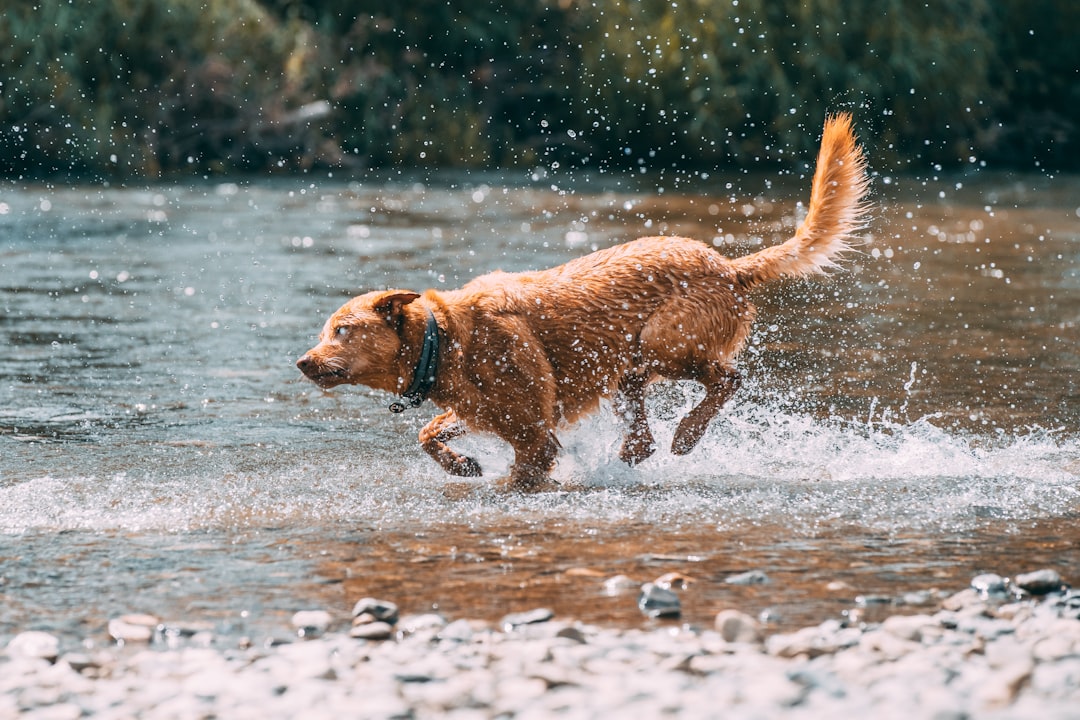
Every body of water in this region — every creek, every lake, every river bend, every canal — has alligators. The Florida Fish and Wildlife Conservation Commission estimates roughly 1.3 million alligators across all sixty-seven Florida counties. They live in freshwater lakes, ponds, swamps, and slow-moving rivers. The St. Johns qualifies on every count.
The FWC's guidance for pet owners is direct: keep pets on a leash and away from the water's edge. Never let them swim in fresh or brackish water. Alligators are most active between dusk and dawn, but encounters can happen at any hour. Dogs are particularly vulnerable because their size and splashing can attract attention.
This doesn't mean your dog can't enjoy the trip. It means the trip operates on a leash — literally — and you don't let the leash reach the waterline. On trails at Dunns Creek or Welaka State Forest, the paths often parallel water but don't require water contact. At fish camps, the dock areas and launch ramps are working spaces where awareness matters more than avoidance. The behavioral adjustment is simple: your dog hikes with you, eats with you, rests at the rental with you, but does not swim in open water unsupervised.
Ocala National Forest supports Florida's largest concentration of black bears — roughly twelve hundred animals. The Forest Service maintains a food storage order requiring all food, garbage, and scented items stored in bear-resistant containers, hard-topped vehicles, or suspended food hangs.
For dog travelers, this means securing pet food. Do not leave bowls outside your tent, RV, or cabin overnight. Do not store open pet food bags in a cooler on the porch. If you're camping near the Ocala NF boundary — which includes sites along the springs corridor and parts of the Welaka area — treat pet food, treats, and feeding bowls the same way you'd treat human food: locked in the vehicle or in a bear-resistant container every night.
Your dog on a leash is not the bear attractant. Your dog's food left unattended is.
The practical shape of a pet-friendly trip on the St. Johns is a split itinerary. Dog days and non-dog days.
On dog days, you hike Dunns Creek, explore Welaka State Forest, walk the Ravine Gardens loop, fish from a dock at Georgia Boys, or drive the back roads between anchor towns with the windows down. These days are full days.
On non-dog days — if your group wants to swim Silver Glen or paddle Juniper — someone stays with the dog, or you leave the dog secured at the rental and plan the springs visit as a half-day outing. The trip doesn't shrink because the dog is along. It splits into two kinds of days, and both kinds are worth having.
Dunns Creek State Park — 320 Sisco Rd, Pomona Park, FL 32181 ($5/vehicle). Ravine Gardens State Park — 1600 Twigg St, Palatka, FL 32177. Welaka State Forest — 794 CR 309, Welaka, FL 32193 ($2/person day use, honor system). Georgia Boys Fish Camp — 217 Butler Dr, Satsuma, FL 32189.
Florida State Parks and Welaka State Forest both require six-foot handheld leash at all times. No retractable leashes.
Pets are not permitted in day-use areas at Silver Glen Springs, Juniper Springs, Salt Springs, or Alexander Springs inside Ocala National Forest. This applies to all pets, not just dogs.
If an alligator poses a threat to people, pets, or property, call FWC's Nuisance Alligator Hotline at 866-FWC-GATOR (866-392-4286).
Secure all pet food, treats, and feeding bowls in a vehicle or bear-resistant container overnight. Do not leave pet food outside unattended.
Properties that accommodate dogs fill on a different timeline than standard rentals in this corridor. If your trip includes the dog, the rental search starts earlier — not because inventory is scarce, but because the subset of pet-friendly properties with fenced yards or proximity to trail access is smaller than the full market. Starting the search early means choosing the right base, not settling for what's left.
Want to feature your business on the DirectStay Blog?
Want to feature your business on the DirectStay Blog?

Connect with travelers, share your space, and join a community of hosts earning together.
Become a host