

 DirectStay

Some places ask you to move through them. Hickory Run State Park has a corner that asks you to stop entirely. The Boulder Field — a 16-acre expanse of red sandstone and quartz conglomerate boulders, some of them up to 26 feet long — sits at the northeastern edge of the park in a configuration that hasn't substantially changed in roughly 20,000 years. There are no trails across it. You either step out onto the rocks or you don't. Most people who reach it stand at the edge for a few seconds before they realize the feeling isn't wonder exactly — it's suspension. The earth looks like it was mid-sentence when it froze. Hickory Run as a whole is a 15,990-acre park with 44 miles of hiking trails, a swim beach, and a waterfall trail system. Whether you come for the stillness or the movement shapes a very different afternoon.
The boulder field earned its status as a National Natural Landmark — and it earns attention even before you know that.
The formation sits in a small valley, nearly level with the path that approaches it. There's no dramatic drop, no summit moment. You walk through a pine forest and then the trees end, and in front of you is a field of boulders so dense and so flat-topped that the whole thing reads as floor rather than terrain. The rocks beneath you extend roughly 10 to 12 feet deep. The widest span runs about 1,800 feet east to west.
Geologically, the field is a product of periglacial processes — the freeze-thaw cycles and glacial melt that fractured upslope bedrock and redistributed boulders over successive cold periods. The boulders have remained mostly unchanged for over 20,000 years. The result is a landscape that looks implausible — a flat, treeless expanse dropped into the middle of a forested mountain park.
What the field asks of you physically is attention. There are no maintained trails across it. Footing varies. Some rocks wobble underfoot. Most visitors walk out 50 to 100 feet, pause, and then either keep going or turn back. Both responses are reasonable.
The Boulder Field can be reached by car or on foot.
By car, the access road is a 5-mile one-way dirt loop — unpaved, and not maintained in winter due to lingering ice and snow, which typically closes it until spring. There's a dedicated parking lot at the boulder field for visitors who drive.
On foot, the Boulder Field Trail is 3.5 miles out-and-back from its trailhead, rated more difficult. Round-trip hiking to the boulder field adds 7 miles — a commitment that filters out same-day visitors trying to combine it with the lake and waterfall trails.
For most day-trip visitors, the car-access route is the KNOW BEFORE YOU GO choice. It preserves enough energy to walk the field itself, which is more physically demanding than it looks.
The boulder field anchors one neurological experience. The trail network in the rest of the park is a different register entirely.
Sand Spring Lake is the park's swim area — a sand beach open from late May through mid-September, 8:00 AM to
sunset. Swimming is unsupervised (swim at your own risk), and the water is calm enough for families with younger children. A snack bar is on-site during beach season.
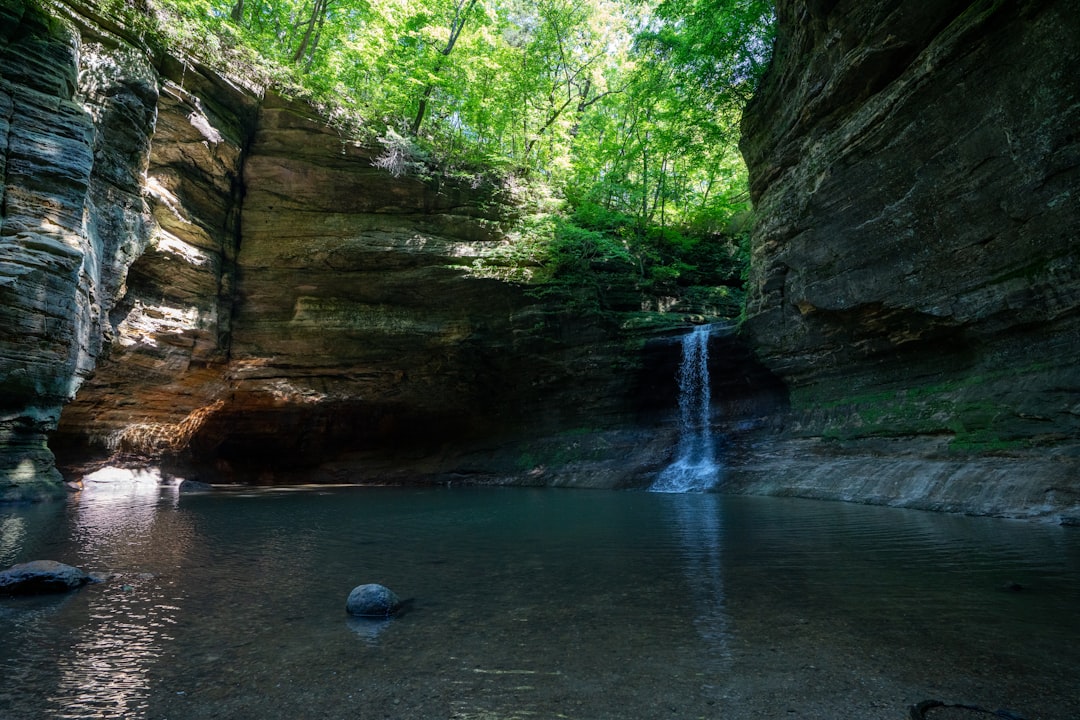
Hawk Falls Trail is a 0.6-mile loop on the park's eastern end that passes through a tunnel of rhododendron before ending at a 25-foot natural waterfall. The trail is often icy in winter. Note: swimming is prohibited at Hawk Falls — the designated swim area is Sand Spring Lake only.
Shades of Death Trail (the name is purely geographic) is a 1.0-mile out-and-back that follows Sand Spring Run, passing small natural cascades and larger waterfalls at man-made dams. It is also often icy in winter, and is one of the quieter routes in the park for visitors who want distance from the main trailheads.
Saylorsville Falls is near the entrance of Camp Shehaqua at Saylorsville Dam — a smaller formation, less a destination than a natural complement to the area near the dam.
Across its 44 miles of trails, the park spans a range of difficulty levels, from easy loop trails around the day-use area to more demanding routes through the interior. Several trails are open to cross-country skiing in winter; others accommodate snowmobiling. The Lehigh River runs along the park's western border and is open year-round for fishing.
The park's two experiences aren't easily combined into one tight half-day. They sit in different corners of a 15,990-acre property, and the boulder field road access adds setup time.
If you're organizing around the boulder field: Arrive early. DCNR notes that parking at trailheads can reach capacity early in the day, even on weekdays. Build time for the unpaved road access and allow for an unhurried walk across the field — rushing it removes the entire point.
If you're organizing around trails and swimming: Sand Spring Lake, Hawk Falls, and Shades of Death Trail can be combined in a half-day without the boulder field at all. The campground entrance and main trailheads are easily accessible, and trail distances are manageable for most groups.
If you want both: Arrive when the park opens. Do the boulder field first while the road is quiet. Return to the main area for trails in the afternoon. This order keeps the sensory shift intact — stillness before movement, not the reverse.
Address: 3 Family Camp Rd, White Haven, PA 18661
Phone: 272-808-6192
Hours: Daily, sunrise to sunset. Day use areas close at dusk.
Beach season: Late May through mid-September, 8:00 AM to sunset. No lifeguards — swim at your own risk.
Boulder Field road: Unpaved, one-way, approximately 5 miles. Not maintained in winter; closed due to ice and snow until spring. Verify current access before visiting in late fall or early spring.
Hawk Falls Trail: 0.6-mile loop. Often icy in winter. Swimming prohibited at the falls.
Shades of Death Trail: 1.0 mile out-and-back. Often icy in winter.
Cell service: Unpredictable throughout the park. Download the trail map before arriving.
Reservations: Day use areas do not require reservations. Overnight camping and cottages are reservable through PA DCNR online or by calling 888-PA-PARKS (888-727-2757), Monday–Saturday, 7:00 AM–5:00 PM.
The boulder field is the kind of landscape that photographs don't prepare you for — the scale reads differently in person, and the flatness of it, which seems unremarkable in images, is the thing that stops people. It's worth seeing once for that reason alone.
The rest of the park is the reason to stay longer.
If your group splits naturally between people who want to stand still and people who want to keep moving, Hickory Run is one of the few places in the Poconos where both ends of that preference are genuinely satisfied in the same visit
Want to feature your business on the DirectStay Blog?
Want to feature your business on the DirectStay Blog?

Connect with travelers, share your space, and join a community of hosts earning together.
Become a host