

 DirectStay

Ninety miles of barrier island separate three lighthouses built to solve the same problem — ships kept wrecking on this coast. Each tower answered the dark differently. One left its brick bare. One painted itself in horizontal bands. One twisted its stripes into a spiral and stood taller than anything else on the coast. What pulls you toward one instead of another has less to do with history than you'd expect. It has more to do with what kind of morning you want, how far you're willing to drive, and whether the climb matters more than what surrounds the tower at ground level. The Outer Banks lighthouse corridor stretches from Corolla at the northern tip to Buxton deep on Hatteras Island, and which one you visit — or whether you visit all three — says something about how you're actually spending your time on this coast.
Currituck Beach Lighthouse stands in Corolla's Historic Village with its red brick fully exposed — the only major lighthouse on this stretch of coast that was never painted. That was intentional. When it was first lit on December 1, 1875, mariners needed to distinguish it from the black-and-white towers to the south during daylight. The bare brick was its daymark.
The climb is 220 steps. No advance reservation, no digital ticket scramble — you pay at the tower and go. The 2026 season runs March 21 through November 30. At the top, the view opens across Currituck Sound to the west and the Atlantic to the east, with the Whalehead historic estate visible below and the Corolla wild horse corridor stretching north into the four-wheel-drive zone.
What makes Currituck different isn't the lighthouse itself. It's the density of what's adjacent. The Whalehead Club, the Outer Banks Center for Wildlife Education, the village shops, the proximity to wild horse tour departures — all within walking distance. A visit here folds into a Corolla morning that already has momentum.
The original First Order Fresnel lens is still operational, cycling every 20 seconds. The smaller Keeper's dwelling nearby serves as a museum shop. Managed by the nonprofit Outer Banks Conservationists, the grounds stay open year-round.
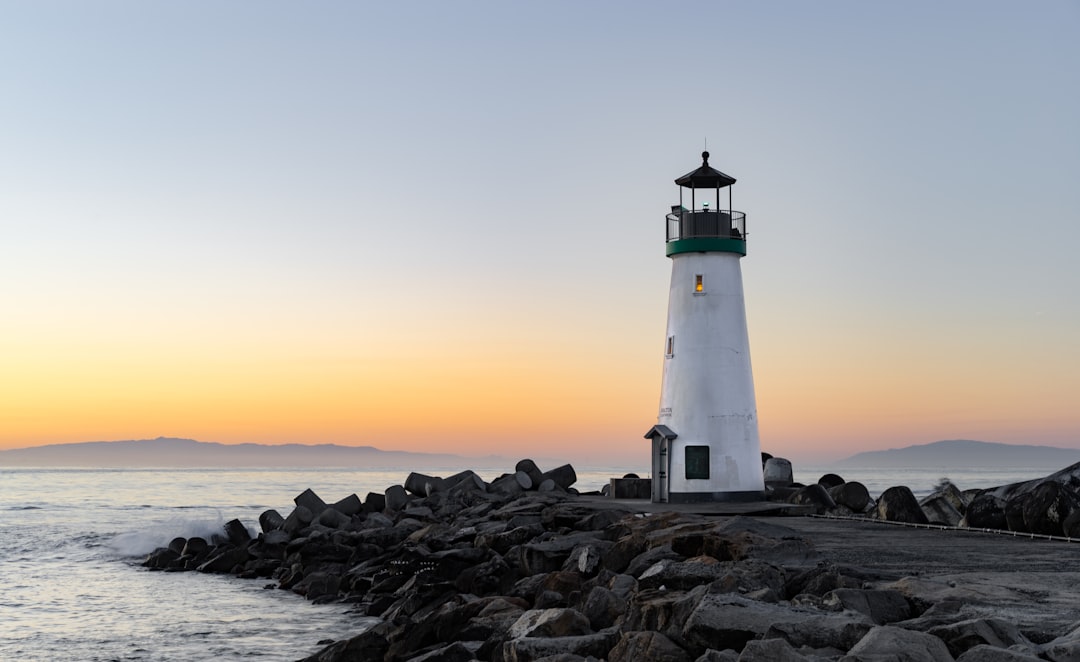
Bodie Island Lighthouse sits in a different landscape entirely. South of Nags Head, where NC-12 enters Cape Hatteras National Seashore, the horizontal black-and-white bands rise above a flat expanse of salt marsh and maritime scrub. There's no village around it. No adjacent shopping district. The setting is the point.
The climb is 219 steps with nine landings, and the stairwell narrows as you go — one person per flight, no exceptions. Tickets go through Recreation.gov at 7 a.m. on the day of your climb, and they sell out. The lighthouse typically opens mid-April and closes mid-October. Around 170 tickets are available each day.
What distinguishes Bodie Island is what you encounter before and after the climb. A boardwalk extends into the surrounding marsh, passing through habitat where migratory birds cycle through depending on the season. Coquina Beach is across the road. The lighthouse still operates its original First Order Fresnel lens — one of the few in the country — making a full rotation every 27.5 seconds.
One current detail: the Double Keepers' Quarters, which housed the visitor center, sustained fire damage in January 2025 and remains closed indefinitely. Rangers are on site, porches accessible, but the interior exhibits are unavailable. The climb itself is unaffected.
Cape Hatteras Lighthouse is the tallest brick lighthouse in North America — over 200 feet of spiral staircase, with the black-and-white spiral stripe that has become shorthand for the entire Outer Banks. It sits in Buxton, deep in Cape Hatteras National Seashore, roughly an hour and twenty minutes south of central OBX on NC-12.
You cannot climb it in 2026. A $19.2 million restoration project that began in late 2023 continues through at least the end of the year. Scaffolding surrounds the tower. The iconic paint is stripped. What visitors see right now is the raw structure — exposed brick that hasn't been visible in over a century.
The grounds remain open around the clock. The Museum of the Sea is operational. And the story the museum tells is worth the drive by itself. In 1999, the entire light station — lighthouse and seven historic structures — was relocated 2,900 feet inland to escape the eroding shoreline. The move took 23 days. When the tower was built in 1870, it stood roughly 1,500 feet from the ocean. By the 1990s, the water had closed to within a few dozen feet. Standing at the original foundation marker and looking back at where the lighthouse sits now makes the scale of that decision visceral.
Currituck Beach is the easiest to fold into an existing Corolla day. Bodie Island adds 15 minutes from Nags Head and delivers a fundamentally different experience — isolated, marshy, birder-friendly. Cape Hatteras demands commitment. The drive reshapes the day's structure, and right now, the experience is observational rather than vertical.
Visitors who want a climb and a village atmosphere go to Currituck. Visitors who want the climb plus the quiet and the marshes go to Bodie Island. Visitors drawn to the engineering story — the relocation, the restoration, the scale — go to Hatteras even knowing the tower is closed.
All three were built within a seven-year span: Cape Hatteras lit in 1870, Bodie Island in 1872, Currituck Beach in 1875. The same construction drawings were reused between Bodie and Currituck. But the landscape around each has diverged so completely that visiting all three in a single day feels like crossing between different coasts.
Currituck Beach Lighthouse: 1101 Corolla Village Road, Corolla. Open daily March 21 – November 30, 9 a.m. – 5 p.m. Tickets purchased in person at the tower. Check current admission and seasonal updates: obcinc.org/currituck-beach-lighthouse
Bodie Island Lighthouse: 8210 Bodie Island Lighthouse Road, Nags Head. Climbing season typically mid-April through mid-October. Tickets available only on the day of climb via Recreation.gov — sales open at 7 a.m. Visitor center interior closed (fire damage, January 2025); rangers on site. Check NPS for current conditions: nps.gov/caha
Cape Hatteras Lighthouse: Buxton, within Cape Hatteras National Seashore. Climbing closed through at least the end of 2026 (restoration). Grounds open 24 hours. Museum of the Sea open. Virtual climb tour available: nps.gov/hdp/exhibits/caha/tour. Check restoration updates: nps.gov/caha
Conditions: All lighthouses close during severe weather. NPS lighthouses require climbers to be at least 42 inches tall. Check each site for weather closures.
Summer weeks fill the northern beaches and central OBX well in advance. Guests planning a lighthouse corridor day that reaches Hatteras Island should expect the drive to reshape the schedule — building in an early departure and treating the return as wind-down keeps the trip from compressing. Booking ahead opens up quieter options with more space across the barrier islands.
Want to feature your business on the DirectStay Blog?
Want to feature your business on the DirectStay Blog?

Connect with travelers, share your space, and join a community of hosts earning together.
Become a host