

 DirectStay
A Myrtle Beach trip earns its own escape hatch. The Conway Riverwalk gives you one of the most complete versions of it — a boardwalk above the Waccamaw River where the water runs dark from centuries of tannins leaching out of decaying vegetation, cypress knees break the surface, and the soundtrack drops from whatever was playing on Ocean Boulevard to herons and boat wakes. You have left the beach zone. You are inland, fifteen miles removed, in one of the oldest towns in South Carolina. The Riverwalk doesn't thin the crowd; it replaces the crowd with a different geography entirely. Then there's the path that keeps your feet in the sand. Garden City Beach sits at the south end of the Grand Strand — low-rise houses where the high-rises stop, a pier you walk for free, a beach that runs without the commercial density that compresses the middle of the strip. The escape here isn't distance. It's diffusion: the same coast, measurably quieter.
Most travelers default to staying coastal when a break from Myrtle Beach's density means a break from the beach. That instinct makes sense — you came for the water, the drive is short, and the geography of the Grand Strand keeps pulling you back. The Riverwalk works precisely because it breaks that logic.
Conway sits about fifteen miles west of the beach zone. Founded in 1732, it's one of the oldest towns in South Carolina — laid out on a bluff above the Waccamaw River as an inland port, its economy running for centuries on tobacco and turpentine shipped downriver. The Grand Strand built itself around Conway, not the other way around.
The Riverwalk runs about 1.2 miles of boardwalk and paved path along the river. The water stops people: it runs dark, the color of strong tea, stained by tannins leaching from the decaying vegetation in the surrounding wetlands. Cypress knees push through the shallows. The Waccamaw River Memorial Bridge — built in 1937, listed on the National Register of Historic Places, its Gothic-arched concrete piers honoring Horry County residents who served in every American war from the Revolution through World War I — passes overhead on one section, giving the walk a layered sense of time that the beach never quite manages.
The path is flat and ADA accessible throughout. Benches and a gazebo sit along the route for pausing with the river rather than just moving through it. A marina, boat launch, and arboretum anchor the far end. The walk is free.
But the walk earns more if you continue into downtown Conway afterward. The latest Riverwalk expansion — completed in February 2025 — now connects the boardwalk directly to Main Street, so the transition from river to historic district is seamless. A half-day that starts at the river and ends over lunch in town feels genuinely elsewhere.
The Riverwalk handles event spillover from Myrtle Beach particularly well. When the strip runs a major event — bike week, a summer festival, a weekend where Ocean Boulevard slows to a crawl — Conway sits structurally upstream of all of it. No event pressure reaches the Riverwalk. The crowd physics don't apply inland.
Garden City Beach doesn't ask you to leave the coast. It asks whether you're on the right part of it.
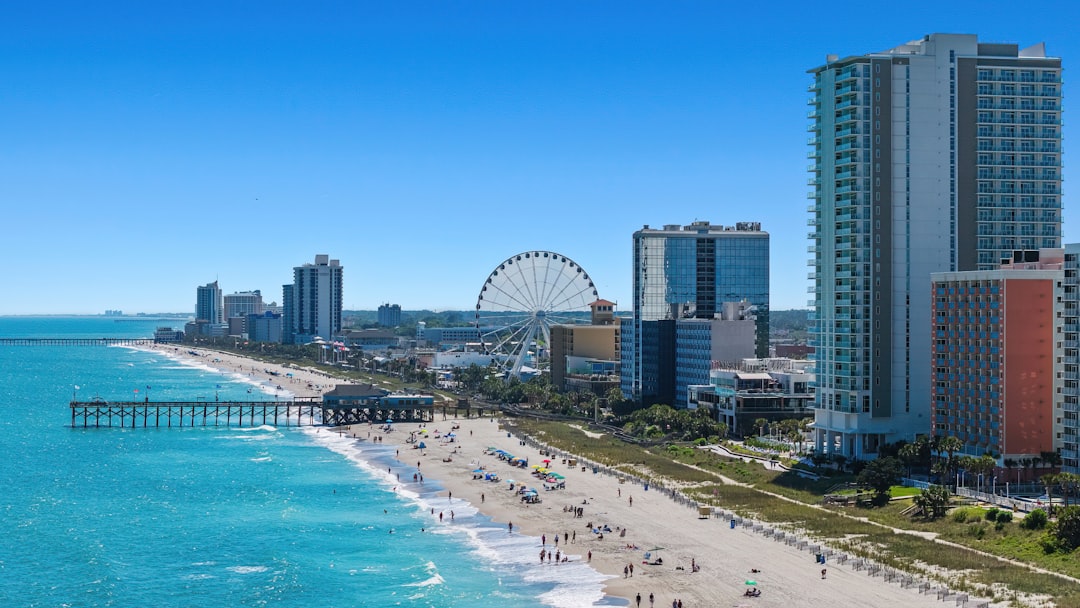
The Grand Strand runs about sixty miles. The commercial density of central Myrtle Beach — the high-rises, the boardwalk strip, the event compression — sits toward the middle. The south end runs differently. Surfside Beach flows into Garden City Beach, which continues toward the mouth of Murrells Inlet, and the development pattern shifts: low-rise condos, beach houses, properties that face the same Atlantic Ocean with measurably less infrastructure around them.
Garden City Beach spans two counties — Horry and Georgetown — and that administrative split reinforces the sense of having drifted out of the main strip's orbit. The beach carries the same sand, the same water, but without the crowd density that gathers around concentrated attractions. Fewer vendors. Less ambient noise. Room to spread on a summer afternoon when the central beach is shoulder-to-shoulder.
The Pier at Garden City is the gathering point — free to walk, with fishing by day and live music most evenings during the season. At 668 feet into the Atlantic, it doesn't carry the commercial scaffolding of Myrtle Beach's main pier zone. People use it because it's there and it works.
But the crowd decay at Garden City follows the same physics as any beach on the Grand Strand: the middle hours fill, the early mornings and late afternoons open back up. The difference is the baseline — fewer people to begin with means the cleared hours feel genuinely open rather than merely less full.
Event spillover from Myrtle Beach affects both options differently. When the central strip runs a major event, the compression moves inward and upward through the hotel and condo density. Conway is structurally outside that radius — fifteen miles inland, a different town, a different county. Garden City absorbs some spillover by proximity, but the absence of high-rise clusters means the crowd spreads rather than stacks.
Time of day matters more at Garden City than at Conway. The Riverwalk is consistent across the day — river pace doesn't accelerate at 2 PM. The beach at Garden City runs through crowd cycles like any beach. Morning and late-afternoon hours tend to recover what midday builds.
The choice turns on what kind of break you're after. The Riverwalk breaks the coastal register entirely — different terrain, different sound, different pace, with a historic town directly attached now that the 2025 expansion connects boardwalk to Main Street. Garden City keeps the coastal register and lowers the intensity within it.
Neither is a workaround. They're two definitions of away.
Conway Riverwalk runs along the Waccamaw River in downtown Conway, SC, about fifteen miles inland from Myrtle Beach. The Riverwalk extends approximately 1.2 miles from the river confluence at Kingston Lake north to 4th Avenue at the Highway 905 bridge, with the newest section (opened February 2025) connecting directly to Main Street. Flat, paved and boardwalk throughout, ADA accessible, stroller friendly, dogs on leash welcome. Free. For current conditions and event programming: conwaysc.gov.
Parking at Conway Riverwalk: Access points at 2nd Avenue (parking lot on-site) and off Laurel and Elm Streets; Riverfront Park has a lot at 6 Elm St. Free two-hour parking is available in the downtown area. Verify current details at conwaysc.gov.
Downtown Conway is now directly connected via the 2025 Riverwalk expansion. Hours and availability for individual shops and restaurants vary — check ahead before planning a specific stop.
Garden City Beach runs south of Surfside Beach along the South Strand, approximately 8 miles south of central Myrtle Beach. The Pier at Garden City (110 S Waccamaw Dr, Garden City Beach, SC 29576) is the area's central landmark — free to walk, fishing pass required to fish (no state license needed with pier pass). Live music runs most evenings during summer season; hours vary. Current schedule at pieratgardencity.com.
Beach access rules differ across Horry and Georgetown counties — including evening closure times and seasonal dog restrictions. Verify current regulations for both counties before visiting: horrycounty.org and gtcounty.org.
Parking at Garden City Beach tightens on summer weekends. Arriving before midmorning is the most reliable plan during peak season.
Event spillover note: During major Myrtle Beach events, traffic and crowd density in surrounding areas typically increase. Conway remains structurally outside the event zone. Garden City Beach is less affected than the central strip but shares the broader coastal corridor.
Accommodations in the surrounding communities put both within easy reach without the pricing premium of the central strip. Booking ahead opens up quieter, more spacious options at either end of the strand.
Two ways out from the same starting point. One leads inland to a river the color of dark tea and a town that was already centuries old when the coast was just a bluff. One leads down the strand to where the strip goes quiet and the sand opens up. The escape that works is the one that answers what you actually needed a break from — the energy of Myrtle Beach, or just the compression of it.
Want to feature your business on the DirectStay Blog?
Want to feature your business on the DirectStay Blog?

Connect with travelers, share your space, and join a community of hosts earning together.