

 DirectStay
A family wildlife morning near Palmer comes down to one question: do you want to understand the animal or touch it? There's the conservation path — a 75-acre nonprofit where Ice Age survivors stand behind fences while a guide explains why their underwool reshaped Arctic economics. The Musk Ox Farm doesn't let you pet the animals. It lets you grasp why they matter — and why a fiber combed from their backs each spring reaches villages where Alaska Native women knit it into garments warmer than anything sheep ever produced. Then there's the path where grain fills your palm and a reindeer's breath warms your fingers before you've finished the sentence you were saying to your kid. A three-generation family farm at the foot of Bodenburg Butte where the animals aren't behind glass or ropes — they're eating from your hand, bumping your elbow, making your six-year-old laugh in a way no screen ever has.
Most visitors to the Musk Ox Farm expect a petting zoo. What they walk into is a working conservation farm disguised as a pastoral afternoon. The nonprofit traces its origins to 1954, when anthropologist John J. Teal Jr. recognized that rural Alaska Natives had almost no way to earn cash income without leaving home. His answer wasn't a factory or a mine. It was an animal — one that had survived the same millennia as woolly mammoths and saber-tooth tigers, and happened to grow one of the finest fibers on the planet beneath its shaggy outer coat.
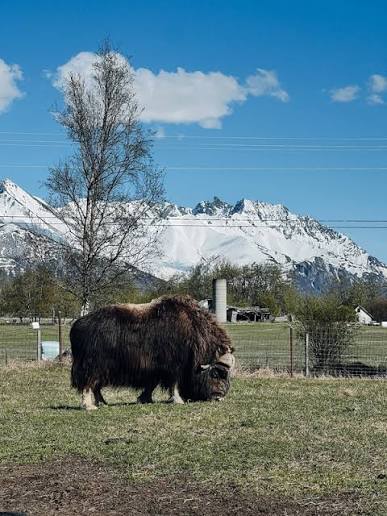
That fiber is qiviut. Eight times warmer than sheep's wool by weight. Finer than cashmere. No itch, no lanolin, no barbs. Every spring, the farm's staff hand-combs it from each animal — a process gentle enough that the musk oxen stand for it. The fiber travels to the Oomingmak Musk Ox Producers' Cooperative, where Alaska Native women in remote villages knit it into hats, scarves, and smoke rings using traditional patterns unique to each community.
The walking tour takes you through pastures where 70-plus musk oxen graze against a backdrop of the Chugach and Talkeetna ranges. Calves born each spring stumble through the grass near their mothers. The guides know individual animals by name and temperament. You'll learn how musk oxen form defensive circles — a strategy that worked against wolves for ten thousand years but failed catastrophically against rifles in the nineteenth century, nearly driving them to extinction in Alaska before a congressional reintroduction effort in the 1930s brought Greenland animals to Nunivak Island.
You leave knowing something you didn't know before. Not just about an animal — about a fiber economy, a cooperative labor model, and an Arctic survival strategy older than agriculture itself.
The Reindeer Farm sits at the base of Bodenburg Butte on land the Williams family has worked for three generations — originally a dairy operation carved from the 1935 Matanuska Colony Project, the Depression-era resettlement that brought farming families from the upper Great Lakes to Alaska's most fertile valley. The dairy is gone. What replaced it is something no guidebook fully prepares you for.
You walk in. Someone hands you a cup of grain. And then a reindeer is there — soft nose, warm breath, antlers you didn't expect to be that close to your face. The herd ranges from a hundred to three hundred animals depending on the season. But reindeer aren't the only residents. Dolly the bison was bottle-fed by the family. Rocky the moose tolerates visitors with the patience of someone who's heard every joke. Apollo the elk watches from a distance that suggests he's seen enough.
🏠 HOST INSIGHT OPPORTUNITY: "What do you tell guests about these places that they wouldn't find online?"
✅ IF HOST PROVIDES WISDOM: "But the part that changes everything is [HOST INPUT HERE]."
⬇️ ALTERNATE (if no host wisdom): "But the thing most visitors discover too late is that both farms sit within minutes of each other — close enough to do both in a single morning. The families who get the most from the day start at the Musk Ox Farm, where the pace is quieter and the learning lands while attention is fresh, then drive to the Reindeer Farm where the energy shifts to touch and laughter and the kind of sensory overload that kids process through their hands."
The guides here know every animal's personality and backstory. The tours move at a pace set by the animals themselves — if a moose calf decides to cross the path, the tour waits. If a reindeer nuzzles your toddler's jacket, nobody rushes the moment.
What you take home isn't knowledge. It's a physical memory — the weight of antlers, the texture of a reindeer's nose, the sound your kid made when an animal three times their size ate gently from their open palm.
The tension between these farms mirrors a tension in every family trip: do we learn something or do we feel something? The honest answer is that both farms do both — the Musk Ox Farm earns emotion through understanding, and the Reindeer Farm teaches through contact. But the emphasis is different, and so is what sticks.
At the Musk Ox Farm, your teenager might remember the cooperative — that women in villages hundreds of miles from any road earn income because someone in the 1950s looked at a shaggy Ice Age relic and saw an economic model. At the Reindeer Farm, your five-year-old might remember the exact moment a reindeer chose their hand over everyone else's in the group.
Neither memory is smaller than the other. They just live in different parts of the brain.
Where (Musk Ox Farm): 12850 E Archie Rd, Palmer. Located on a historic 1930s Colony farm east of downtown Palmer off the Glenn Highway.
Where (Reindeer Farm): 5561 Bodenburg Loop, Palmer. At the foot of Bodenburg Butte, south of downtown Palmer via the Old Glenn Highway.
Proximity: The two farms sit minutes apart — close enough to visit both in a single morning.
Tours: Both farms operate guided tours. The Musk Ox Farm runs walking tours with the last tour typically departing at 4 PM. The Reindeer Farm offers guided and self-guided experiences. Both recommend booking in advance during summer. Check each farm's website for current tour times and seasonal availability: muskoxfarm.org and reindeerfarm.com.
Seasonal note: Both farms are open year-round, though hours shift by season. The Reindeer Farm operates by appointment during winter months. The Musk Ox Farm's winter schedule brings the herd to front pastures — closer viewing, fewer crowds. Verify current hours before planning around either.
Bodenburg Butte: The Reindeer Farm sits near the Sandvik Family trailhead — a roughly 750-foot climb with 360-degree valley views. Families often combine the farm visit with the hike. Allow 1–2 hours round trip for the butte.
Lodging note: Palmer-area wildlife mornings fill quickly during summer. Guests staying in surrounding communities can build a full wildlife day — both farms plus Bodenburg Butte — without needing to return for anything. Booking lodging early opens up quieter options outside town center.
Want to feature your business on the DirectStay Blog?
Want to feature your business on the DirectStay Blog?

Connect with travelers, share your space, and join a community of hosts earning together.
Become a host