

 DirectStay

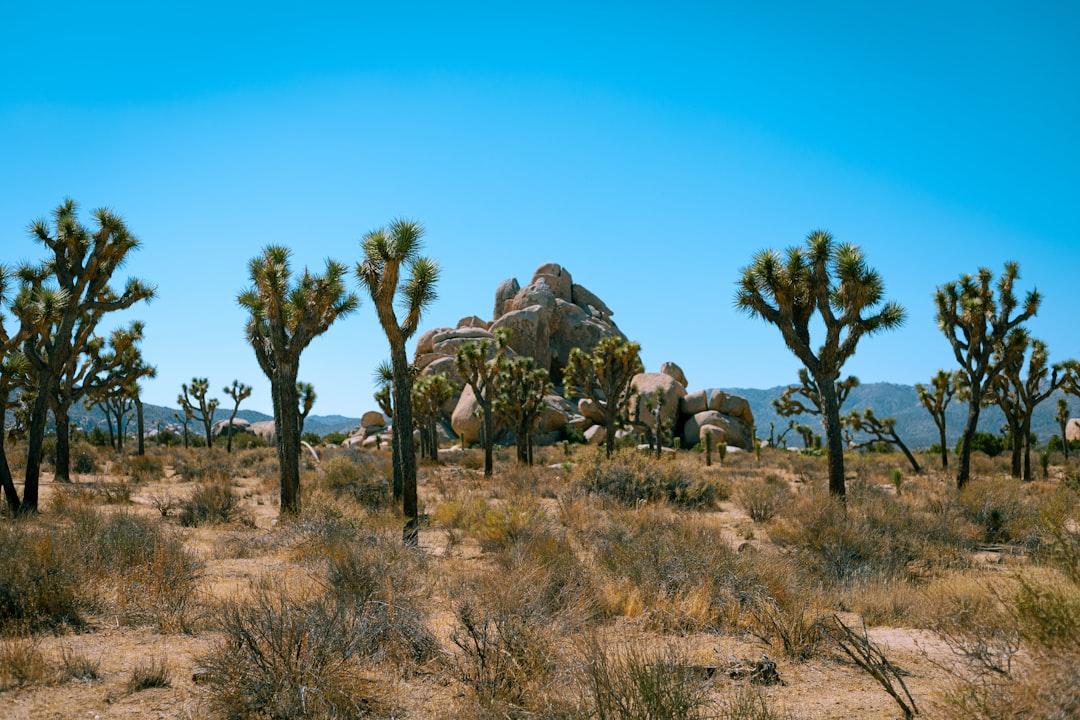
The east side of Joshua Tree pivots on a single question: did you come to photograph the desert, or to disappear into it? Park Boulevard runs roughly twenty miles between the West and North Entrances, and somewhere past the mid-park junction the granite stacks begin to tower. Skull Rock sits right at the road's edge — you can see it from the driver's seat before you've found a parking spot. But the further east you drive, the deeper the rock pulls you off pavement and into corridors where the trails thin, the crowds drop away, and the formations stop looking like anything you can name.
This is the section of the park where a one-hour scenic drive and a full-day scrambling expedition share the same parking lots. The question is which version you walked in for.
Skull Rock earns its name without effort. Two hollowed eye sockets carved by centuries of water erosion stare out from a massive granite boulder, and you can spot them before you've unbuckled your seatbelt. The parking area sits directly on Park Boulevard — walk seventy feet and you're standing beside it.
That accessibility is the draw and the limitation. On spring weekends, the roadside parking fills and cars line both shoulders for a quarter mile. The formation itself takes ten to twenty minutes if you're there for the photo. But most visitors never walk past the rock.
The Skull Rock Nature Trail extends 1.7 miles as a loop that circles through the Jumbo Rocks area, crossing Park Boulevard and threading through the campground before looping back. The trail passes through boulder washes, sandy terrain, and interpretive signs explaining the monzogranite geology. The crowds thin within the first few minutes. A connector called the Discovery Trail links Skull Rock to the Split Rock Loop, stretching the available hiking to roughly five or six miles for those who keep walking.
The landscape here hosts vegetation from multiple Mojave elevation zones — Joshua trees, Mojave yucca, juniper, pinyon, nolina, creosote, jojoba, and various cholla. What looks barren from the road is dense with life once you step off asphalt.
Jumbo Rocks sits adjacent to the Skull Rock trailhead, and the distinction between "campsite" and "exploration zone" blurs the moment you see the boulder stacks surrounding each site. The campground's towering granite formations create natural rooms, and visitors — camping or not — wander the edges where the trail passes through.
This is unstructured territory. There is no single "Jumbo Rocks hike." The experience is wandering among boulders that dwarf the vehicles parked between them, finding nooks that frame the desert sky, and scrambling low-grade rock that rewards curiosity more than fitness. Plan a loose block of time here, not a trail checklist.
Arch Rock requires a different posture. The trailhead sits at the Twin Tanks parking lot on Pinto Basin Road — further south and east than the Park Boulevard corridor, and noticeably quieter. The 1.4-mile lollipop trail heads east on sandy terrain before reaching a short loop where the namesake granite arch appears roughly halfway around.
The arch itself spans roughly thirty feet — a natural granite formation worn into shape by time. A spur trail leads to Heart Rock, adding about three-tenths of a mile. The total experience runs well under an hour at a moderate pace, but the area invites off-trail scrambling through the surrounding boulder field.
What sets Arch Rock apart from the roadside formations is what happens after dark. The area sits far enough east that Palm Springs light intrusion diminishes, and the granite arch creates a natural frame for astrophotography. White Tank Campground is adjacent — campers can walk to the arch at night for star trail compositions that use the formation as foreground. Daytime visitors should note: parking at White Tank is reserved for campers. Day-use parking is at Twin Tanks only.
Hall of Horrors occupies a different category entirely. The NPS describes it as "a popular destination for scrambling and rock climbing," but that undersells the experience. The parking area sits on Park Boulevard between Ryan Campground and Sheep Pass Group Campground, roughly in the park's center — a transition point between the west-side icon circuit and the east-side boulder corridor.
A 0.6-mile loop circles two large clusters of stacked granite. That loop is flat and easy. But the experience most visitors are looking for — the narrow slot canyons hidden inside the second boulder cluster — requires route-finding and scrambling over rock to locate the entrance. Two slot canyons thread through the boulders: one wider and shorter, one narrow enough in places that you turn sideways to pass. The tighter corridor squeezes to under a foot wide at its most narrow point.
This is not a marked trail. The NPS asks that visitors use existing climber access paths to minimize impact. Families with adventurous kids do it regularly, but the scrambling and tight spaces require comfort with unstructured movement on rock. If slot canyons feel like a stretch, the loop walk alone delivers impressive views of the Joshua tree forest and surrounding mountain ridgelines.
The connective thread across these stops is Park Boulevard itself. Driving east from the mid-park junction along Park Boulevard, the landscape shifts. The open Joshua tree woodland gives way to denser granite stacks — the Jumbo Rocks and Skull Rock corridor concentrates the park's most dramatic boulder formations. The formations grow stranger, more piled, more maze-like.
This shift means the east side rewards a different kind of attention. The west-side circuit — Hidden Valley, Barker Dam, Cap Rock, Keys View — concentrates high-yield stops within a tight driving radius. The east side stretches that radius and asks you to decide: pull over, photograph, and move on? Or park, leave the trail, and lose an afternoon in granite corridors that don't appear on any map?
Both are the right answer. The difference is what you came to the desert for.
Starting point: The east-side corridor begins roughly at the intersection of Park Boulevard and Keys View Road (Cap Rock area) and extends toward the North Entrance at Twentynine Palms.
Skull Rock: Parking is directly on Park Boulevard. On spring weekends, arrive before 9 AM or expect roadside overflow parking and a quarter-mile walk. The 1.7-mile loop trail is sandy with some rocky sections and minimal
shade. No wheelchair access on the trail, though the formation itself is viewable from the road.
Jumbo Rocks: Campground access is for campers; the Skull Rock Nature Trail passes through it. Exploration of the boulder field requires no permit — just common sense and sun protection. The NPS notes that Jumbo Rocks has a high concentration of bees, especially in warmer months — keep food and water covered.
Arch Rock: Park at Twin Tanks (not White Tank Campground — that's campers only). The 1.4-mile lollipop trail is mostly flat, sandy, with some rocky terrain. No shade. Heart Rock spur adds 0.3 miles.
Hall of Horrors: Paved parking lot with vault restrooms on Park Boulevard. The 0.6-mile loop is easy. The slot canyons require scrambling and are not accessible for strollers or wheelchairs.
Water and shade: None available at any of these stops. The NPS recommends at least a gallon of water per person per day — carry more than you think you need, and drink before you feel thirsty. Summer visitors should complete all outdoor activity before 10 AM.
Cell service: Unreliable to nonexistent along this corridor. Download the NPS app with offline trail maps before entering the park.
Conditions: Trail surfaces range from deep sand to uneven rock. Check current conditions at nps.gov/jotr before planning.
Spring weekends compress parking and trail access across the east-side corridor. Guests staying in surrounding communities benefit from dawn starts — an early arrival means the formations belong to you before the day-trippers arrive. Planning lodging in advance opens up quieter options outside the gateway towns.
Want to feature your business on the DirectStay Blog?
Want to feature your business on the DirectStay Blog?

Connect with travelers, share your space, and join a community of hosts earning together.
Become a host