

 DirectStay

Most visitors to Indiana, Pennsylvania, plan ninety minutes for the Jimmy Stewart Museum. They park along Philadelphia Street, climb to the third floor of the library building, move through the galleries, sit for part of a matinee in the fifty-seat theater, and walk out feeling like they’ve done the thing. They have — the museum is thorough, well-curated, and worth every minute. But the thing nobody tells you is that Jimmy Stewart’s presence didn’t stay inside the building. It leaked out onto the sidewalk, settled into the courthouse lawn, climbed a set of stairs to a house on a hill, and embedded itself in the crosswalk signals you’ll hear if you press the button at the right intersection. The museum is the starting point. The town is the rest of the visit. And the town takes longer than you think.
The Jimmy Stewart Museum sits on the third floor of the building at 835 Philadelphia Street — the same building that houses the Indiana Free Library. That placement matters. Stewart himself was hesitant about a museum in his honor, but agreed on the condition that it stay humble, stay downtown, and benefit the community economically. It opened on his birthday, May 20, 1995, with his twin daughters in attendance.
Inside, the galleries move chronologically through his life — not just the Hollywood career, but the family roots in Indiana, the Princeton years, the decorated military service as a WWII bomber pilot, and the decades of work that produced over eighty films. His military uniforms are here. His Distinguished Flying Cross is here. A recreation of his California office sits alongside a replica of his childhood bedroom. The vintage theater rotates weekly matinees at 1 PM daily — always a Stewart film, always in a room that holds fifty seats and feels like someone’s living room.
What the museum does well is resist the impulse to make Stewart larger than life. The exhibits feel more like a conversation with a neighbor than a tribute to a celebrity. His father’s hardware store gets as much attention as his Oscar. The family’s involvement in Indiana’s civic life — from volunteer fire companies to war memorials — occupies gallery space alongside the Hollywood posters. You leave knowing more about the man than the movie star.
Plan sixty to ninety minutes. Longer if you sit for the full matinee.
Step outside and the experience doesn’t stop. It just changes form.
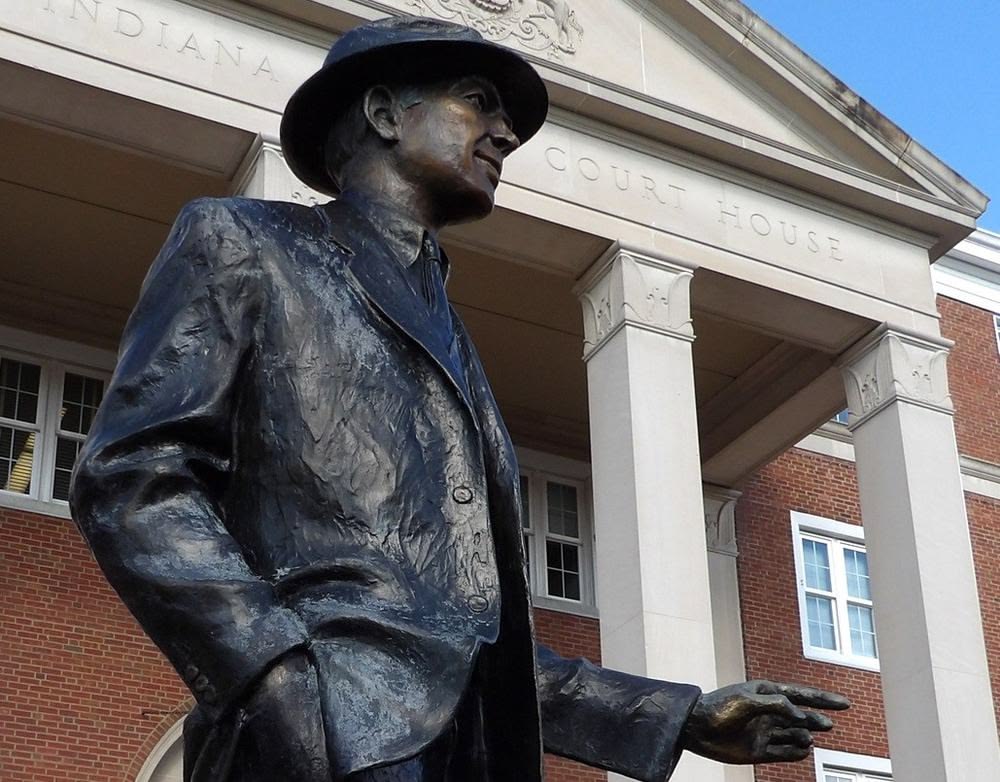
The nine-foot bronze statue of Stewart stands on the courthouse lawn at the corner of 8th and Philadelphia Streets — directly adjacent to the museum building. Sculptor Malcolm Alexander, who also captured Roberto Clemente and Joe DiMaggio, created the likeness. Stewart himself approved it, though he reportedly left the final word to his wife Gloria. The statue was dedicated on his 75th birthday in May 1983 — the last time he visited Indiana.
Cross Philadelphia Street from the statue and you’re standing where his father’s hardware store once stood. J.M. Stewart & Co. Hardware occupied that spot for decades — a three-story building where Alex Stewart ran the business and famously kept his son’s Academy Award in the front window for years. The store closed after Alex’s death in 1961 and the building was razed in 1969. A bank occupies the site now, but the historical markers tell the story, and the original sundial from the storefront is preserved in the library lobby downstairs from the museum.
One block west on Philadelphia Street, a bronze plaque marks the doorstep of Stewart’s birthplace at 965 Philadelphia Street. Walk east instead, turn onto Jimmy Stewart Boulevard, and follow the concrete steps up Vinegar Hill. His boyhood home sits at 104 North 7th Street — still a private residence, still at the top of those stairs. On the way back down, the view opens to a panorama of downtown Indiana that includes the Victorian-era courthouse — the same one that appeared on the cover of a 1945 Life Magazine commemorating Stewart’s return from the war.
The crosswalk voice signals sit at two intersections along Philadelphia Street — 7th and 9th Streets. Rich Little, who recorded over a hundred clips for the project, provided the familiar drawl. The borough installed them in 2009 at a cost of roughly three hundred dollars, thanks to donated labor and materials. They replaced the standard chirping signals, and they’ve been catching visitors off guard ever since.
It’s the kind of detail that turns a museum visit into a story you tell when you get home. The museum gives you the history. The crosswalk gives you the moment.
Further down Philadelphia Street at 637, the Indiana Theater has been part of the downtown fabric since it opened on July 16, 1924. The three-hundred-seat venue shows films and hosts live events, and its marquee is one of the more photographed facades on the street — particularly at dusk, when the neon warms against the courthouse silhouette. During the annual holiday season, when downtown Indiana leans into its connection to It’s a Wonderful Life, the theater becomes part of the Bedford Falls atmosphere that settles over the town each November and December.
The museum is the anchor, but the walking tour is the experience. Everything sits within a few blocks of Philadelphia Street. A visitor who parks once and walks deliberately can cover the museum, the statue, the hardware store site, the birthplace plaque, the Vinegar Hill steps, the crosswalk signals, and the theater in a single unhurried morning or afternoon. None of it requires a car once you’ve parked.
The festival season intensifies everything. The annual Jimmy Stewart Festival in summer fills the courthouse square with programming and draws visitors who might not have come for the museum alone. The It’s a Wonderful Life celebration in late November and December wraps the downtown in holiday energy that makes the Bedford Falls comparison feel less like a marketing hook and more like a description of what’s actually happening.
For photographers, the golden-hour window matters. The courthouse silhouette against the theater marquee’s warm neon — roughly thirty minutes before sunset — is the shot most people came for, whether they knew it or not.
Where: Downtown Indiana, PA — concentrated along Philadelphia Street. Museum, statue, hardware store site, theater, and crosswalk signals all sit within a few walkable blocks.
Museum: 835 Philadelphia St, 3rd floor. Check jimmy.org for current hours, admission, and the weekly matinee schedule.
Parking: Metered street parking throughout downtown. Indiana Borough’s parking garage at 650 Water Street is an alternative. Check current rates locally.
Accessibility: The museum is on the third floor. Its building elevator was listed as out of service at last check, so call (724) 349-6112 to confirm before visiting with anyone who can’t manage stairs. Downtown sidewalks are flat with curb cuts. The Vinegar Hill steps are not accessible — the view from the base of the stairs is still worth the walk.
Festival timing: The Jimmy Stewart Festival typically falls in summer. The It’s a Wonderful Life celebration historically runs in late November through December. Verify current-year dates before planning around either event.
Festival weekends and the holiday celebration draw visitors from across Western Pennsylvania and beyond. Accommodations in surrounding communities fill earlier than a typical weekend during these windows. Planning ahead and booking in advance opens up quieter, more spacious options outside the borough center.
Want to feature your business on the DirectStay Blog?
Want to feature your business on the DirectStay Blog?

Connect with travelers, share your space, and join a community of hosts earning together.
Become a host