

 DirectStay

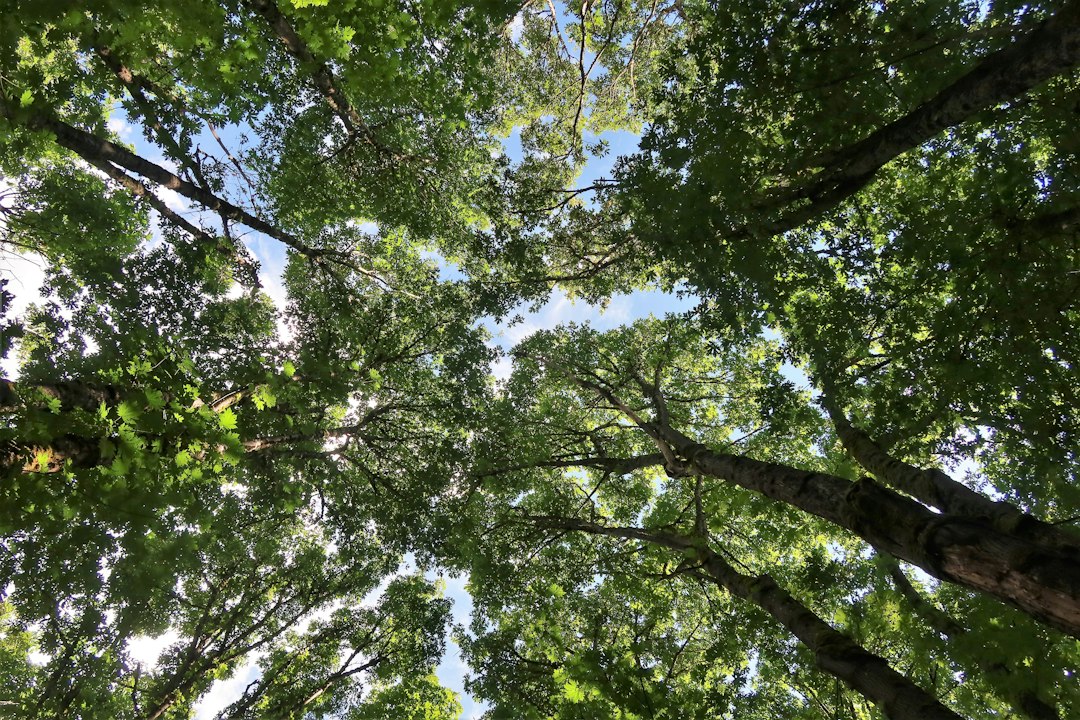
White’s Woods doesn’t announce itself. The North 12th Street entrance sits at the edge of a residential neighborhood — houses on one side, 245 acres of hardwood forest on the other. Step past the trailhead and the shift is immediate. Street noise drops. The canopy thickens — oak, maple, pine, tulip poplar, magnolia — and the trail tilts uphill into terrain that feels farther from downtown Indiana than the five-minute drive suggests. The 2.5-mile loop starts climbing almost immediately, which is the first thing the park doesn’t warn you about. This isn’t the Hoodlebug. There’s no pavement, no flat grade, no railbed logic. The surface is natural soil and root, the elevation changes are real, and the forest floor holds mud for days after rain. What it gives back depends on when you walk in.
Before 7 AM on a weekday, White’s Woods belongs to the dog walkers and the trail runners. The deer, which have adapted to human traffic so thoroughly that they barely lift their heads, stand in clearings close enough to photograph without a zoom lens. The light through the canopy in early morning falls in long shafts — the kind photographers wait for but hikers stumble into.
The main loop takes most people about an hour and a half at a steady pace, though the side trails pull you deeper if you let them. There are over ten marked and unmarked paths threading through the interior, running toward the IUP Student Co-op’s forest on the south side and to Fulton Run Road on the west. The Co-op side is private university property and is currently closed to the public, so the boundary is where your walk turns around. The trail signage is — to put it generously — inconsistent. Multiple visitors over the years have noted the same thing: the paths are well-worn enough to follow, but the markers are sparse or missing in sections. A navigation app or downloaded trail map is worth having the first time through.
What the morning gives you is the forest at its quietest and most structural. The understory reveals itself — trillium in spring (one of the park’s at-risk species, along with blue cohosh), fern corridors in summer, and in October, a color display that intensifies because the canopy is dense enough to hold the light. Fall color here is not panoramic. It’s overhead and immediate — you walk through it rather than look at it from a distance.
The same trail system at 3 PM is a different place. Students from IUP have long reached the woods from the campus side, where the forest and the university’s land meet with no gate or clear boundary marker. Dog walkers fill the lower loops. Trail runners circle the main loop in both directions. The solitude of dawn gives way to a forest that functions more like a neighborhood park — which, for White Township, is exactly what it is.
This is the version of White’s Woods that earns its reputation as an urban forest in a place that doesn’t feel urban. The campus bleeds into the canopy. A student walking from a lecture hall to the trailhead covers the distance in minutes. For visitors, the North 12th Street entrance is the way in. The IUP Student Co-op’s adjoining forest is closed to the public during a forestry project that runs into 2027, and the boundary between the two isn’t always marked. Stay on White’s Woods trails.
The afternoon light in White’s Woods shifts the experience from solitude to immersion. The sounds change — more birdsong, more movement in the understory, more awareness that this forest sits in the middle of a living community. Birders know this spot: eBird lists it as a recognized hotspot, and the species variety reflects the diversity of habitat packed into 245 acres.
No restrooms anywhere on the trails. No water fountains. No paved sections — the entire trail system is natural surface, which means it is not ADA accessible and not stroller-friendly on the elevation sections. After heavy rain, the lower trails hold mud that can turn a moderate hike into a slow negotiation. Proper footwear matters here more than most local trails.
There’s also a disc golf course woven through part of the woods — if you hear plastic hitting trees, that’s what’s happening.
White’s Woods has been at the center of a conservation disagreement between White Township and a community group called Friends of White’s Woods since 1995. The core issue: the township has periodically proposed logging portions of the forest, while residents and conservation advocates argue the land — purchased with Pennsylvania’s Project 70 funds — was designated for recreation, conservation, and preservation, not timber revenue.
The most recent chapter moved toward resolution. A stewardship committee of community volunteers spent over two years developing a preservation and conservation plan. DCNR confirmed in early 2026 that the plan is consistent with Project 70 requirements, and the township announced that finding in March 2026. Friends of White’s Woods commended the committee’s process. No logging is occurring in White’s Woods.
The forest next door is a different story. In May 2026 the IUP Student Cooperative Association began a multi-phase forestry project on its adjoining College Lodge forest, which runs into 2027 and has drawn opposition from Friends of White’s Woods and a community petition. That land is private university property, and its trail is closed to the public while the work continues.
For visitors, the dispute doesn’t change the trail experience today. But it’s the reason the forest looks the way it does — dense, largely unmanaged, and maturing toward old growth in some sections. The community fought for that. It’s worth knowing when you walk through it.
The forest rewards different visits at different times of year. Spring brings the wildflower understory — trillium, blue cohosh, and fern emergence along the lower trails. Summer deepens the canopy to near-total shade on the interior loops, dropping the temperature several degrees below the surrounding streets. Fall — specifically mid-October — is when the overhead color peaks, and because the canopy is dense, the saturation is intense at close range. Winter strips the leaves and reveals the topography: the ridgelines, the drainage patterns, the shape of the land that the summer canopy hides. The trails remain open year-round, though ice and mud make the steeper sections genuinely challenging from December through March.
Where: North 12th Street entrance, Indiana, PA. Fulton Run Road on the west side is a secondary access. The IUP Co-op side on the south is closed to the public during forestry work into 2027.
Hours: Sunrise to sunset, year-round. No fee.
Trail surface: Natural soil and root. Moderate elevation changes. Not ADA accessible. Muddy after rain — allow extra time and wear appropriate footwear.
Trail length: The main loop runs approximately 2.5 miles. Side trails and alternate routes extend the network. AllTrails maps a 3.8-mile option combining multiple paths. Total trail system covers roughly 6 miles.
Dogs: Welcome. Leash policies vary by source — leash your dog to be safe.
Trail markers: Inconsistent. Download a trail map or use a navigation app for your first visit. The Friends of White’s Woods website has a printable map.
Conservation note: White Township’s stewardship plan for the woods was confirmed by DCNR in 2026. The adjoining IUP Co-op forest is under a separate forestry project through 2027, and its land is off-limits to the public. Stay on White’s Woods trails, carry the downloadable trail map, and check current conditions before planning:White Township Recreation orFriends of White’s Woods.
White’s Woods sits close enough to downtown Indiana that a morning hike fits naturally into a day that starts at the rental. Park at the 12th Street entrance, walk the loop, and you’re back in time for coffee on Philadelphia Street without moving the car.
Want to feature your business on the DirectStay Blog?
Want to feature your business on the DirectStay Blog?

Connect with travelers, share your space, and join a community of hosts earning together.
Become a host