

 DirectStay

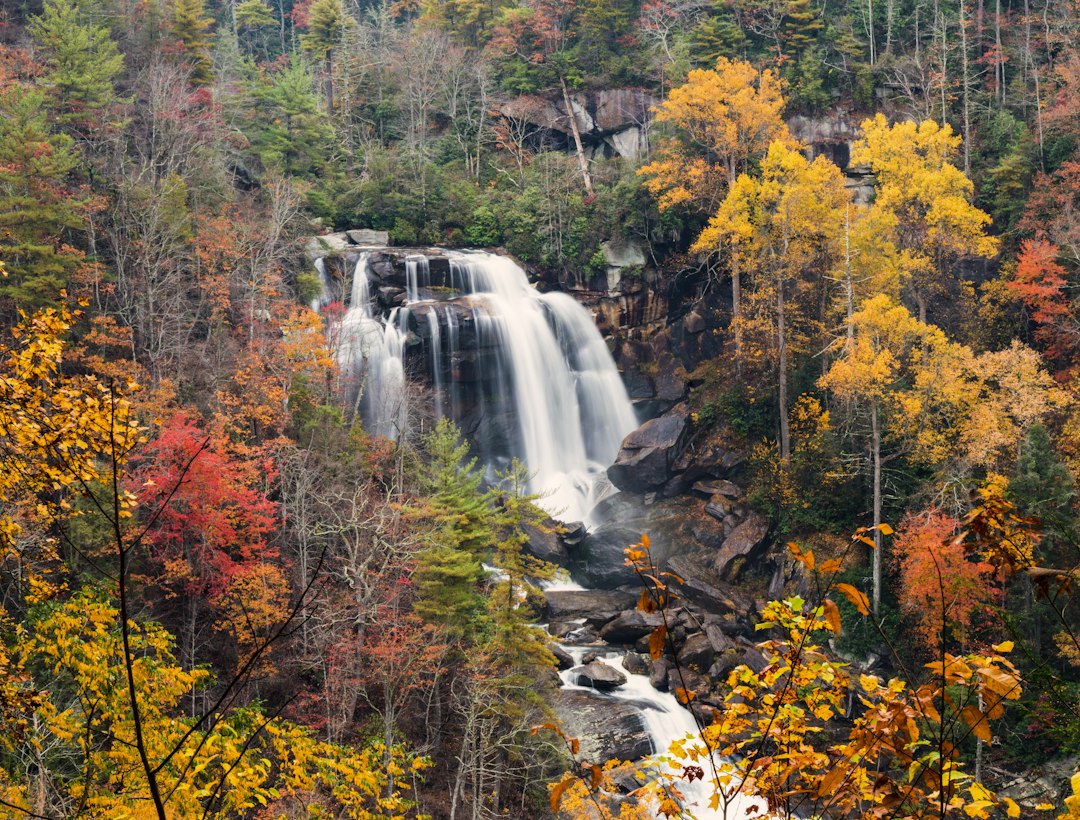
A waterfall in Indiana County asks one question before you reach it: how far down do you want to go? Buttermilk Falls drops forty-five feet through a sandstone ledge into the Hires Run valley, and the trail splits the experience in half. The upper overlook sits two-tenths of a mile from the parking area — flat, crushed stone, wheelchair-accessible, done in ten minutes. You see the falls framed by hemlock and hardwood, hear the water hitting rock, and walk back to the car knowing you saw it. Then there’s the gate. Past the overlook, an A-frame bridge crosses the creek, and four flights of metal stairs descend into the gorge. At the bottom, a platform extends behind the curtain of water itself. The mist hits your arms. The sound changes from something you’re watching to something you’re standing inside. Same waterfall. Two completely different memories.
The upper overlook is not a consolation prize. From above, you see the full forty-five-foot drop and the valley Hires Run carved through sandstone and shale — the kind of scale that disappears when you’re standing at the base looking up. In early spring and after heavy rain, the water volume at the overlook is striking. In midsummer, the canopy fills in enough to partially screen the view, but the sound still carries. Families with strollers, visitors with mobility considerations, and anyone short on time get the full visual from here. It takes less than fifteen minutes round-trip from the car.
What most visitors don’t expect is the trail itself. Ten postcard-sized panels line the path between parking and overlook — flip them up and you’ll find quotes from Fred Rogers. Not decorative plaques chosen by a marketing committee. Quotes from someone who played in this exact gorge as a child, whose grandfather’s estate surrounded these falls for twenty-five years.
Between 1931 and 1956, this forty-eight-acre property belonged to Fred McFeely — a Latrobe industrialist and the maternal grandfather of Fred Rogers. McFeely used it as a retreat. The estate included a cottage, horse stables, a three-car garage, and a swimming area dammed into the creek above the falls. Young Fred Rogers visited regularly as a child, climbing stone walls and crawling behind the water long before any platform or stairs existed.
The stone foundations are still visible near the parking area and upstream along the old swimming dam. You don’t need a sign to spot them — the retaining walls emerge from the forest floor like something between architecture and geology. The McFeely Trail, a short loop through the woods above the falls, passes near several of these remnants. It’s quiet up there. The kind of quiet where you understand why a kid who grew up to build a neighborhood on television spent his summers in this gorge.
Past the upper overlook, you cross the Eclipse Bridge — an A-frame structure completed in 2017, when visitor numbers exceeded 18,000 and the county realized the old scramble path wasn’t sustainable. The bridge itself sits above Hires Run with a clear sightline to the top of the falls.
Then the stairs begin. Four flights of metal steps descend through the gorge wall. The handrails are solid, the treads are grated, and the footing is reliable in dry conditions. This is not a backcountry scramble — it’s engineered infrastructure. But it is steep, and it is physical. Anyone with knee concerns or vertigo should assess honestly from the bridge before committing.
At the bottom, the viewing platform extends behind the waterfall. The perspective reverses entirely — you’re looking out through falling water at the valley you just descended through. The mist is real. In spring, when runoff peaks, you’ll feel it on your face and shoulders. In late summer after a dry stretch, the curtain thins to a veil, and the rock wall behind it becomes the show — mosses, liverworts, the wet geology that makes the falls possible in the first place.
The walk behind the water is the draw. But the moment that earns it is the climb back up — four flights in reverse, breathing harder than you expected, arriving at the overlook with a fundamentally different relationship to the view you saw fifteen minutes ago.
Buttermilk Falls runs year-round, but volume varies sharply by season. Early spring and fall typically bring the highest flows — snowmelt, seasonal rain, and saturated ground keep Hires Run fed. Heavy summer storms can temporarily restore volume after dry stretches, but midsummer is generally the leanest period.
The upper overlook view also changes by season. In full leaf, the canopy partially screens the falls from above — still visible, but framed tighter. In late October through early spring, the bare canopy opens the entire valley, and the falls sit exposed against bare rock and sky. Winter visitors see the most dramatic framing, but the stairs are not maintained for ice or snow. The county doesn’t close the site, but the descent becomes a judgment call that the infrastructure doesn’t make for you.
Where: 570 Valley Brook Rd, New Florence, PA 15944. South of Indiana, approximately 35 minutes via US-22.
Hours: Dawn to dusk, year-round. No gate, no admission fee.
Parking: Small lot at the trailhead — holds roughly a dozen vehicles, with an overflow area near the McFeely Trail. Weekends in peak season fill by midmorning.
Trail: 0.5 miles out-and-back to the falls (upper overlook at 0.2 miles). Part concrete, part crushed stone, then metal stairs and bridge to the base. Upper overlook is wheelchair and stroller accessible. Lower descent is not.
Facilities: Primitive restroom near the parking area. Small picnic pavilion, first-come-first-served.
Swimming: Expressly prohibited. This is a protected natural area — stay on the trail, stairs, and platforms.
Winter access: The site stays open, but the stairs and bridge are not maintained for ice or snow. Upper overlook remains accessible in most conditions. Use judgment on the descent — the county does not gate or close the stairs seasonally.
Conditions: Water volume varies by season and recent rainfall. Check Indiana County Parks for current conditions and any closures: indianacountyparks.org.
Buttermilk Falls is a half-day outing from Indiana — thirty-five minutes each way, with the visit itself lasting anywhere from fifteen minutes (overlook only) to an hour (full descent, McFeely Trail, stone foundations). Travelers staying in the Indiana area can pair this with a stop along US-22 and still have an evening free downtown.
The overlook gives you the photograph. The stairs give you the memory. Fred Rogers didn’t need a platform or a railing — he had a grandfather’s stone walls and a creek full of cold water. The infrastructure changed. The gorge didn’t. Whether you stop at the top or descend to the bottom, you’re standing in the same valley a kid once explored before he understood what it meant to him — and that’s worth more than the waterfall alone.
Want to feature your business on the DirectStay Blog?
Want to feature your business on the DirectStay Blog?

Connect with travelers, share your space, and join a community of hosts earning together.
Become a host