

 DirectStay

The Chattanooga region holds three waterfalls that almost no other place in the country can put on a single map. One lives deep inside a mountain. One sits at the bottom of a thousand-foot canyon. One spills off a sandstone lip into a pool you can swim in. They look like variations of the same experience. They are not. What the traveler actually picks — and what kind of day unfolds from that pick — depends less on the waterfalls themselves than on how the traveler wants to meet them. One waits at the end of a timed cave tour. One waits at the bottom of 600 metal stairs. One waits at the end of a short walk you could make in sandals, then opens its pool to the same sandals in July. Same region, completely different posture toward the people who show up.
All three sit on or near the Cumberland Plateau and share the limestone-over-sandstone geology that builds this corner's cavern systems and canyon-bottom plunge pools. From a downtown Chattanooga base, each is reachable inside a day.
The split is about access. One waterfall has been domesticated: ticket, elevator, paved cavern path, scheduled tour. The second asks for effort — 600 metal stairs down, 600 stairs back up, no alternate route out of the canyon. The third asks for the shortest walk of the three, but the rules are thin: swim hole, climbers working the cliffs on either side, no gate managing the flow.
Ticketed climate-controlled access versus effort-earned open-air access. That's the axis.
Ruby Falls is the one most Chattanooga visitors know by name. The waterfall is 145 feet tall and sits more than 1,100 feet below the surface of Lookout Mountain — the tallest underground waterfall open to the public in the United States. Visitors descend 260 feet by glass-front elevator, then walk a guided cavern trail just under a mile round-trip to the waterfall chamber, where a light-and-sound display illuminates the drop. The full tour runs about an hour.
The operational reality surprises first-time visitors: Ruby Falls requires advance timed-entry reservations. It is not a walk-up experience — tickets are purchased online with an assigned entry window. The cavern holds 60°F year-round, which makes this the region's best rainy-day and peak-summer waterfall.
What Ruby Falls trades for its accessibility is the sense of discovery. The path is paved, the lighting is theatrical, the tour is guided. For travelers with mobility concerns, for families with young children, for anyone who wants a memorable waterfall without earning it through physical effort, Ruby Falls is the clearest answer of the three. The cavern was discovered in 1928 by Leo Lambert, and the 1929 limestone castle at the entrance still serves as the arrival point.
Forty minutes southwest of downtown, across the Georgia line near Rising Fawn, Cloudland Canyon State Park holds the region's most demanding waterfall hike. The Waterfalls Trail drops from the East Rim to the canyon floor, where two waterfalls sit roughly a half-mile apart: Cherokee Falls at the first stop, followed by the taller cascade at Hemlock Falls. The Georgia Department of Natural Resources rates the trail strenuous, with approximately 600 metal stair steps in the one-way descent.
The arithmetic is the part that matters. Six hundred stairs down is manageable for most able-bodied hikers. Six hundred stairs back up — in Southern summer humidity — is where the trail earns its rating. Whatever the traveler carries down, the traveler carries up. The accessible alternative for mixed-mobility groups is the paved Overlook Trail at the same parking area.
Inside the canyon, cell service drops out. Georgia State Parks flags this on their Cloudland Canyon page and at the trailhead. Preload maps. Tell someone the plan.
Flow over both waterfalls shifts dramatically with the calendar. Winter and early spring bring the strongest water; late summer and dry autumns can reduce either falls to a trickle. The Waterfalls Trail, because it filters for people willing to do the stairs, often runs quieter than Ruby Falls or Foster Falls at the same hour.
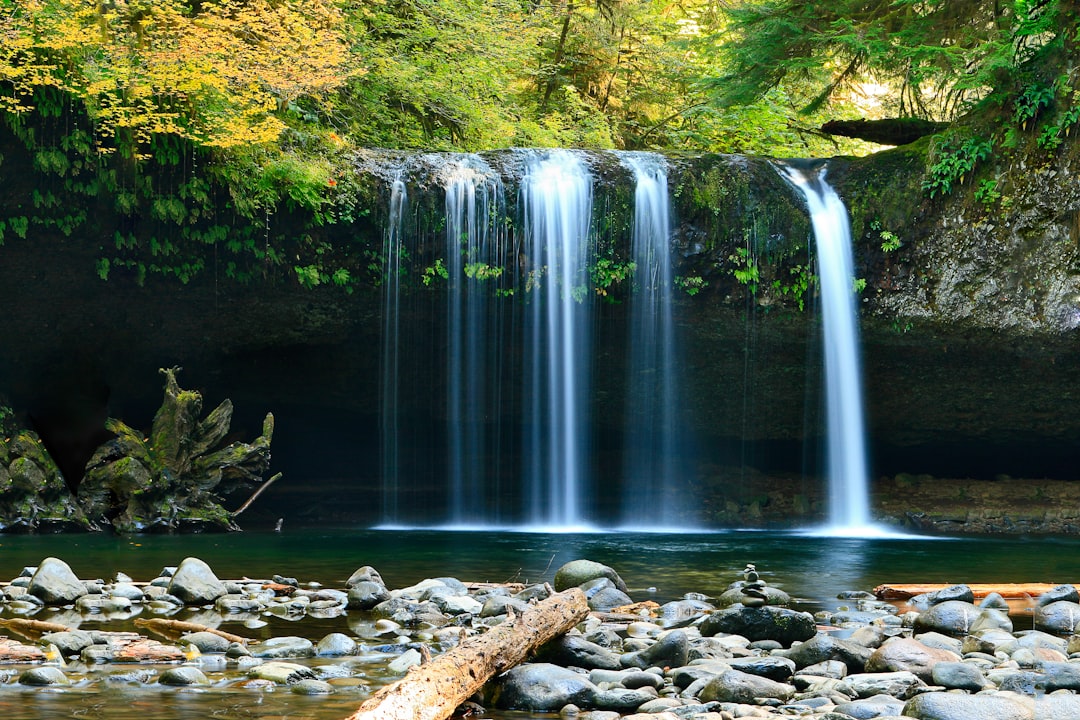
Foster Falls sits about 45 minutes northwest of downtown, part of the Foster Falls Recreation Area within South Cumberland State Park. The waterfall drops 60 feet off a crescent sandstone ledge into a deep turquoise pool at the canyon floor. The descent is short — roughly 0.3 miles of stairs and switchbacks from the parking lot, or a 2-mile Climber's Loop that follows the rim past a viewing platform before dropping into the gorge.
The swim pool is the feature that separates Foster Falls from the other two. In summer, the plunge pool becomes one of the region's busier swimming holes. Peak summer weekends pack the parking lot by mid-morning. Off-season, the same pool sits nearly empty, the falls run harder through winter and early spring, and the sandstone cliffs above become the domain of rock climbers — Foster Falls is one of the Southeast's better-known sport climbing destinations, with more than 150 established routes.
Admission is free. Parking is free. The day-use waterfall carries no entry cost — a contrast with Ruby Falls' ticketed model and Cloudland Canyon's $5 parking fee. What Foster Falls trades for that openness is crowd management. No timed entry, no cap on visitors. Peak summer Saturdays feel it. Weekdays and early mornings feel nothing of the sort.
The framing isn't which waterfall is best. All three are worth the trip on their own terms. The framing is which access matches the day the traveler is actually taking. Rainy afternoon with grandparents in the car — Ruby Falls. Fit-and-hungry hiking day — Cloudland Canyon. Hot afternoon that needs to end in water — Foster Falls. First Chattanooga visit with one waterfall slot — Ruby Falls, unless the traveler is hiking-inclined, in which case Cloudland. Return visit looking for the thing most visitors skip — Foster Falls in shoulder season.
A traveler with three days can see all three. Ruby Falls takes roughly two hours door-to-door. Cloudland's Waterfalls Trail runs three to four. Foster Falls runs two to three, or a half-day if climbing is on the agenda.
Ruby Falls — 1720 South Scenic Hwy, Chattanooga, TN 37409. Roughly 10 minutes from downtown. Timed-entry tickets required — purchase online in advance at rubyfalls.com; tour schedule varies by season, with the earliest entry typically around 8 a.m. and the latest evening entry varying by period. Closed Christmas Day. Cavern holds 60°F year-round — a light layer is useful even in summer.
Cloudland Canyon Waterfalls Trail — Cloudland Canyon State Park, 122 Cloudland Canyon Park Rd, Rising Fawn, GA 30738. Roughly 40 minutes from downtown. $5 daily parking fee (Georgia ParkPass annual option available). Trailhead at the Main/East Rim parking area. Trail is approximately 2 miles round-trip, strenuous, with approximately 600 metal stair steps one way. No cell service in the canyon — preload maps before descending. Accessible alternative: paved Overlook Trail at the same parking area. Flow strongest November–April. Note: the park's permanent Visitor Center is currently under construction; a temporary Visitor Center is operating at the Group Lodge, and entrance road work may produce single-lane traffic during daytime hours — check gastateparks.org before visiting.
Foster Falls — Foster Falls Recreation Area, South Cumberland State Park, Sequatchie, TN 37374. Roughly 45 minutes northwest via I-24 to Exit 134 (Monteagle), then south on US-41. Free admission, free parking. Short 0.3-mile descent to the base, or 2-mile Climber's Loop. Swimming permitted in the plunge pool. Summer weekends fill the parking lot by late morning. Climbing requires a free online permit — register with Tennessee State Parks before every visit; rappelling is not permitted at Foster Falls.
A seasonality note that applies to all three: Southern waterfalls are rain-dependent. After a dry stretch in late summer, Cherokee and Hemlock can drop to a thin flow, and Foster Falls loses some of its thunder. Ruby Falls, fed by steady percolation underground, is the least weather-variable of the three.
Chattanooga's waterfall inventory is not a single experience with variations. It's three distinct answers to the same question — how does the traveler want to meet the falling water? Climate-controlled and scheduled, at the end of 600 stairs, or at the edge of a swim pool where the only clock is sunset. A home base within striking distance of all three turns a three-day visit into a structural survey of how the Southeast delivers its water.
Want to feature your business on the DirectStay Blog?
Want to feature your business on the DirectStay Blog?

Connect with travelers, share your space, and join a community of hosts earning together.
Become a host