

 DirectStay
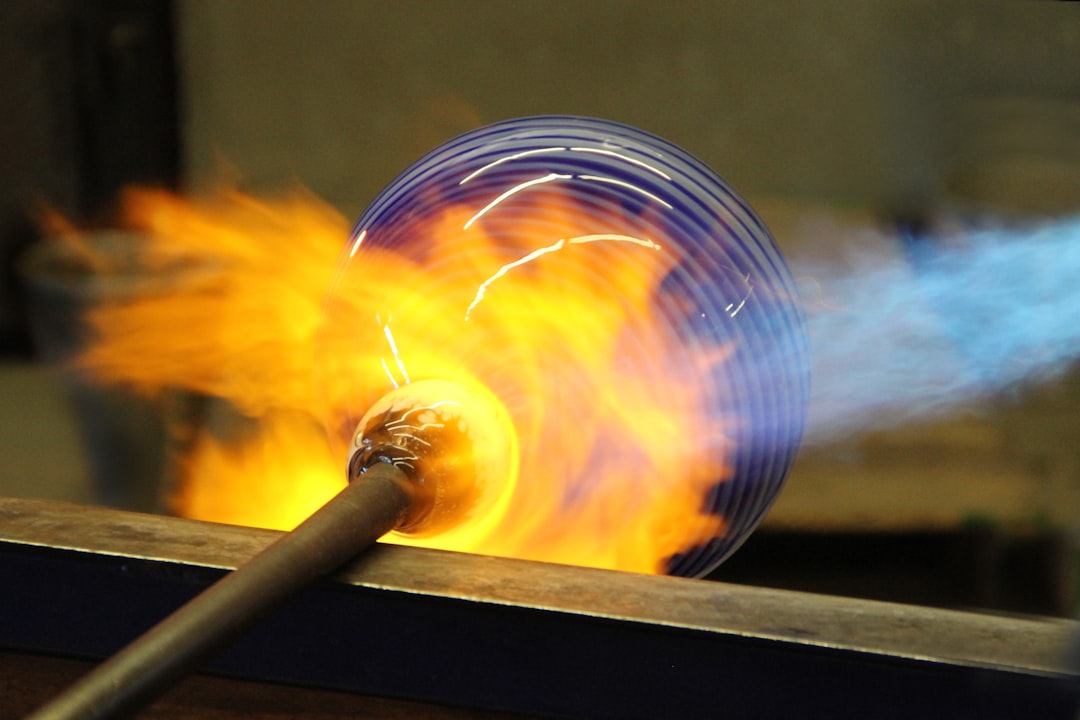
An afternoon in Asheville's River Arts District hits a fork, and the whole thing comes down to what your hands are doing. At Small Batch Glass on Craven Street, they're still. Asher Holman pulls a gather of molten glass from the furnace, and you lean forward without meaning to — the heat reaches you from across the studio while the garage door frames the whole process like a living stage. The pieces lining the walls were made right here, and you're watching the next one take shape in real time, the rod turning, the glass responding. You came in to browse. You've been standing here twenty minutes.
Then there's the path where watching isn't enough — where a few blocks over on Roberts Street, the furnace never cools either, but here someone hands you the blowpipe. The North Carolina Glass Center puts you at the bench beside the instructor, choosing your colors and spinning something into existence that didn't exist ten minutes ago. Your hands are doing the work now, and the distance between watching glass and shaping it turns out to be the whole afternoon.
Small Batch Glass sits across from New Belgium Brewing, and on days when Holman is working, the front garage door stays open. That's not an event. It's not a scheduled demonstration. It's just what a working hot shop looks like when the artist wants you close enough to feel the furnace.
Holman discovered glassblowing at sixteen in San Francisco, studied under Stephen Powell at Centre College, and trained with a master glassmaker in Murano. He worked for other Asheville studios for six years before opening his own space in 2023. The work draws from topographical maps and lighthouse Fresnel lenses — science and craft folded into the same object.
What makes this studio land differently is the scale. This is one artist, one furnace, one conversation between maker and material happening close enough that you hear the glass move. You watch the gather come out of the furnace. You watch the shape find itself. There's no narration, no roped-off viewing area. Just the work, happening in front of you, at a pace that makes you forget you had somewhere else to be.
The gallery doubles as the studio, which means every piece on the wall has a story you just witnessed — or one that happened on a morning like this one. People walk in planning to stay five minutes. They stay through the whole pour.
The North Carolina Glass Center operates on a different premise entirely. This is a nonprofit public access studio — the kind of place built around the idea that glass shouldn't just be observed, it should be attempted.
The center started as Asheville Glass Center in 2009, reorganized as a nonprofit in 2015, and now houses a hot shop, a flame shop, and a cold shop alongside a gallery representing work from dozens of Western North Carolina glass artists. The furnace runs day and night, which is the nature of molten glass — it doesn't wait for you to be ready.
But the draw for most visitors is the thirty-minute "Make Your Own" experience. You sit at the bench with an instructor, choose your form — a cup, an ornament, a paperweight — pick your colors, and work the blowpipe yourself. The glass responds to everything: your breath, your timing, how steady your hands stay when the heat hits your face. It's not a simulation. You're shaping material that's running well north of a thousand degrees, and the instructor is right there guiding every turn.
What changes between walking in and walking out is your relationship to every glass object you'll see for the rest of the trip. You'll pass a blown vase in a gallery window later that afternoon and think about the weight of the rod, the way the gather moved, the moment color bloomed inside the shape.
But the thing most visitors don't account for is the order. Regulars in the River Arts District tend to watch first — let the process settle into your eyes at a studio like Small Batch — and then go make something with your hands at the Glass Center. The doing means more once you've seen what's possible.
Both of these places exist because Asheville's relationship with glass art runs deeper than most visitors realize. Western North Carolina has been a center for studio glass since the 1970s, and the River Arts District holds that tradition in working studios, not behind velvet ropes.
At Small Batch Glass, the experience lives in proximity. You're close enough to feel heat, to hear the tools, to watch decisions happen in real time between an artist and a material that won't wait. The thing you take home might be a piece from the gallery — something made by the same hands you just watched work. Or it might just be the memory of standing still long enough to watch something get made from nothing.
At the NC Glass Center, the experience lives in your hands. You're the one turning the rod. You're the one choosing when to blow. The thing you take home is the object you made — imperfect, heavy with effort, cooling overnight before you can pick it up the next day.
Neither path is lesser. One is about witnessing craft at its most focused. The other is about discovering what the material asks of you.
Two ways to spend an afternoon with glass in the River Arts District. One asks you to be still, to watch someone who's spent a decade learning what the material wants. The other puts the rod in your hands and lets you find out for yourself. The furnace doesn't care which you choose — it just stays hot, all day, every day, waiting for whoever shows up next. The only question is what you came here to do with your hands.
Small Batch Glass 46 Craven Street, Asheville (across from New Belgium Brewing) | River Arts District Glassblowing typically happens mornings when the studio is open — the garage door tells you everything you need to know.
The gallery is open for browsing and purchasing alongside the working studio.
Interactive glassblowing workshops have been known to run on Saturdays and Sundays.
North Carolina Glass Center 140C Roberts Street, Asheville | River Arts District Gallery and studio open Wednesday through Sunday.
The "Make Your Own" experiences run approximately thirty minutes. Verify current schedule as hours may have changed since Hurricane Helene recovery
Planning Notes: Both studios are within walking distance of each other in the River Arts District. No reservations are needed to watch artists work at either location, but hands-on classes at both studios should be booked in advance — especially weekend slots, which tend to fill. Items made during classes need to cool overnight in an annealer before pickup, so plan accordingly if you're passing through for just one day.
Want to feature your business on the DirectStay Blog?
Want to feature your business on the DirectStay Blog?

Connect with travelers, share your space, and join a community of hosts earning together.